
Occasional observations on the wildflowers of 91011.
The flower known as “sweet pea” is a bit of a conundrum. Grown in countless gardens and picked for countless bouquets, without a doubt it smells sweet — just as you’d expect from a flower also known as Lathyrus “odoratus.” But please don’t eat the peas! — because while it is indeed in the “pea” family, it’s by no means edible, despite those familiar peapods.

As you surely know already, charming blossoms don’t make a plant edible. But they do add to the beauty of our planet! And, happily, you don’t need to plant your own ornamental sweet peas to enjoy another member of the same family that grows wild, untended and often unexpected, in our local hills: Pacific Sweet Pea (Lathyrus vestitus), also known as Canyon Sweet Pea. It’s not abundant in our area, but it does turn up on a regular basis.

Like other members of the genus, Pacific Sweet Pea is pleasing to the eye: graceful vines and tendrils that climb where they will, punctuated by impressive clusters of puffy flowers in white or palest pink. These blossoms are usually patterned with marvelous magenta veining, with no two flowers alike. Sometimes the flowers will take on even more dramatic hues of purple, and if you venture south to San Diego, you can find a variety of this species that is entirely rose pink.

California actually enjoys 18 species of native sweet peas! Unfortunately, there are another 11 non-natives found in the wild. Of the latter group, only one is worryingly invasive — Everlasting Pea (L. latifolius), which is an uncontrolled roadside attraction from Monterey north into British Columbia, a beautiful pink sweet pea that smothers other plants and is notoriously difficult to eradicate. All the more reason to love our local variety, with its demonstrated restraint and its modest demeanor!

Pacific Sweet Pea, flourishing in burned chaparral after the 2020 Bobcat Fire
Where and when to find it. Pacific Sweet Pea occurs throughout all the coastal counties of California. It’s found in forests as well as in open chaparral, having adapted to both sun and mixed shade — and it pops up in all kinds of locations. The Verdugo Mtns. and the slopes and canyons of the San Gabriels all have records. Closest to home, a few may be found on the upper Open Space Trail, and there’s a nice little patch along Berkshire Avenue. Indeed, there’s every reason to expect this flower in the shadier places at Cherry Canyon, so send in a photo if you see one! Locally, look for it from March through May, or possibly earlier.
- For more about Pacific Sweet Pea, visit Wikipedia.
- For information about growing Lathyrus vestitus in your yard, visit Calscape.org.
- For distribution maps, taxonomy, and more photos, visit Calflora.org.
- You can also read other wildflower notes, or check out the LCF wildflower directory.
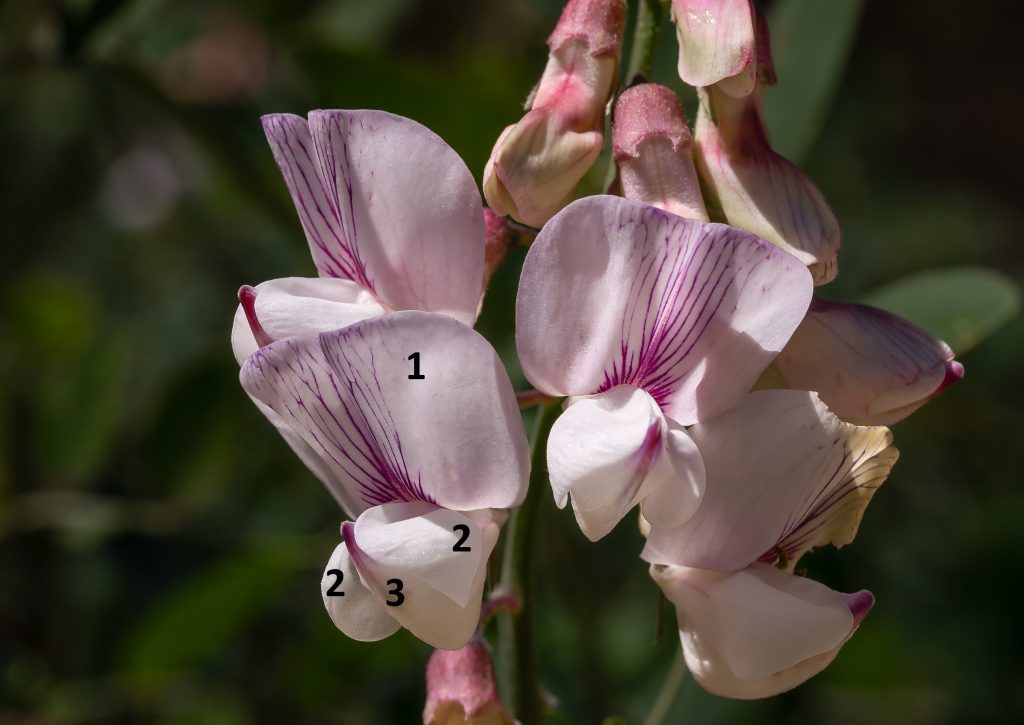
A postscript for budding wildflower geeks: The closeup photos in this post nicely reveal the basic anatomy not only of a sweet pea blossom, but also of similar members of the pea family, like lupines, lotus, and even clover. Basically, there are three parts: the upright back of the blossom is called the banner (1), while the more or less horizontal petals are the wings (2), which largely cover the keel (3)— a horn-like protrusion (also found on lupine blossoms) that will become the seedpod. You can find all three parts on a garden sweet pea, even though its petal parts are relatively large and floppy.
