
Occasional observations on the wildflowers of 91011.
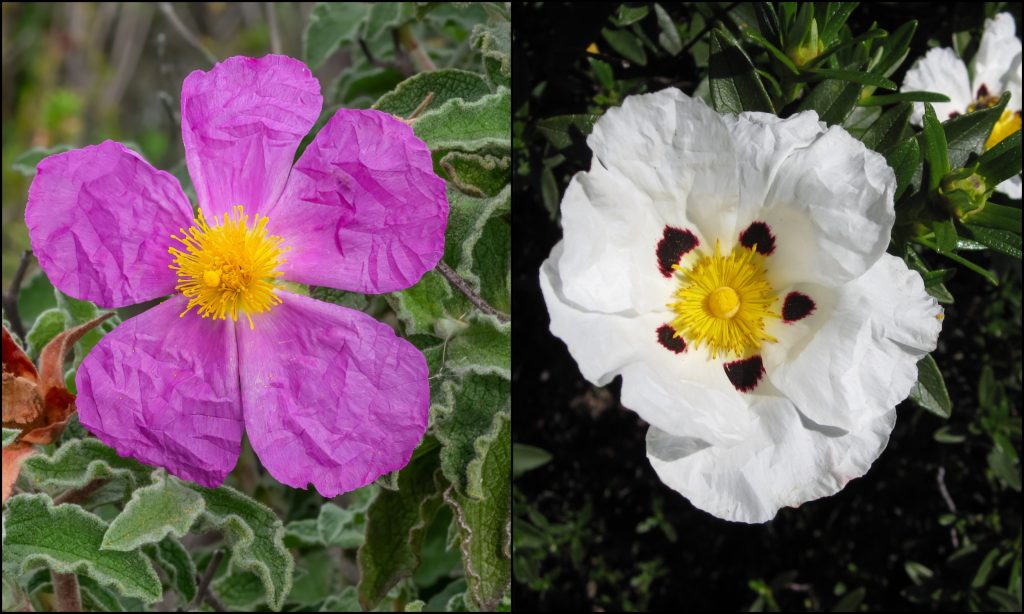
Pink Rockrose (Cistus incanus or C. creticus) is a shrub that you can find in many yards here in La Cañada, perhaps along with its white-flowering counterpart, Crimson-spot Rockrose (C. ladanifer). Both are impressively attractive. Both are also sadly out of place in the wild landscape of California. Not trying to be judgy or anything, but if they can’t keep themselves inside the yards where they were planted, they should have stayed in the Mediterranean basin, in Crete or in Spain, whence they have been imported.
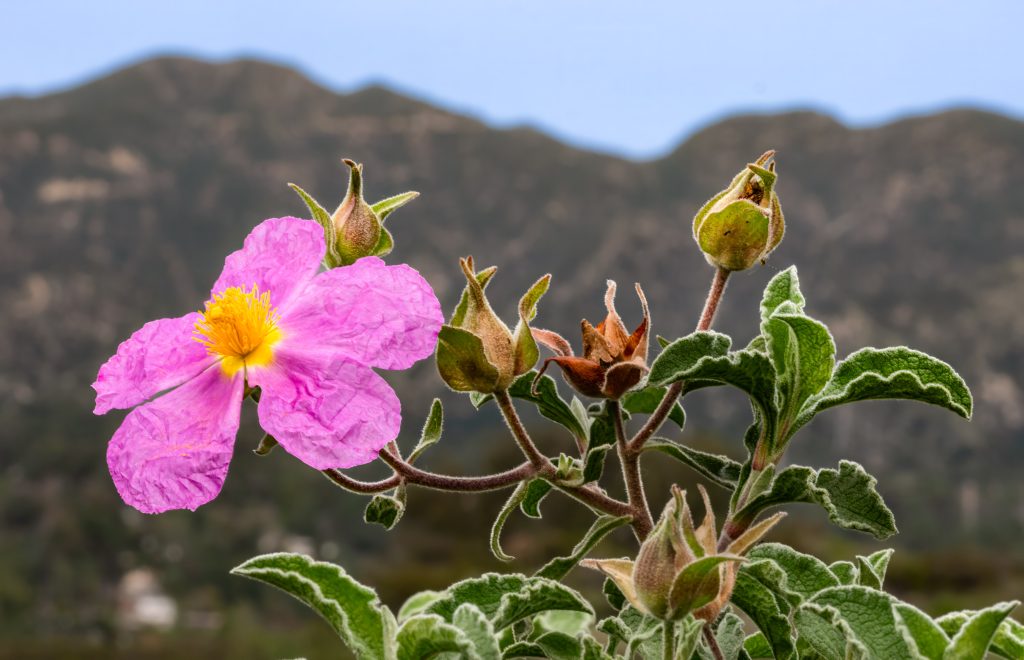
Of course, they were brought here for understandable reasons. Namely — dang! — they’re pretty. And they do really well in a hot and dry environment. There’s a small colony of Pink Rockrose in Cherry Canyon, and you can’t really claim that it’s not a lovely shrub. Both species occur on Mt. Lukens: Pink Rockrose grows about two miles up from the Angeles Crest Fire Station, while Crimson-spot Rockrose flourishes on the nearby Grizzly Fire Road (as well as inside Descanso Gardens, along the road that leads to the west gate). And both are also found along the paved portion of the Sunset Ridge Fire Road that ascends Mt. Lowe.
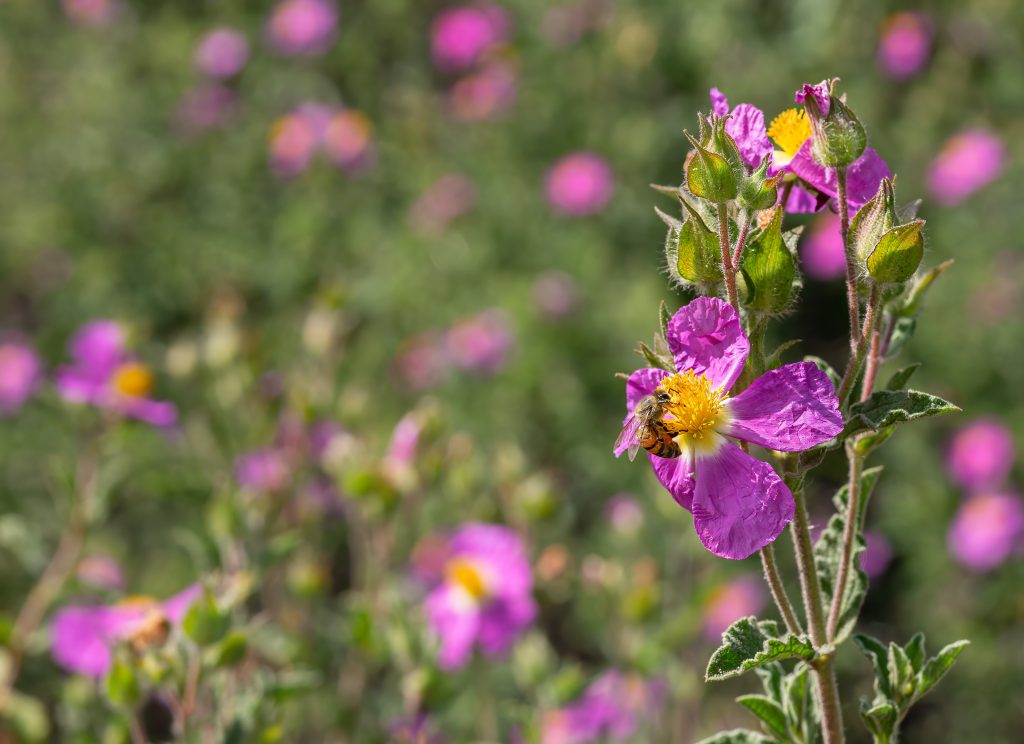
Each shrub produces large wildrose-like flowers in pink or white, with beautiful yellow-orange tufts at the center. Crimson-spot Rockrose typically has dramatic dark red spots at the base of each white petal, though you can occasionally find similar spots on what looks like Pink Rockrose but is actually a cultivated hybrid — “Orchid” Rockrose (C. x purpureas), which flourishes in the main Descanso parking lot. “Ladanifer” in the name of Crimson-spot Rockrose identifies the plant as a source of labdanum, a resin used in making perfume. The following photos give you a glimpse of how the leaves of C. ladanifer are dramatically more resinous (glossy, sticky) than the leaves of C. incanus, where “incanus” means hairy or hoary, as is also obvious from its dull and fuzzy leaves.
As non-native flowers go, these two are not overwhelmingly invasive, though Crimson-spot Rockrose is regarded as a weedy pest in some parts of Spain. Locally, some cities have used Pink Rockrose to stabilize slopes in an attractive way — as Pasadena has apparently done on the hillside south of the freeway overpass that connects Oak Grove Drive to Highland Drive and Linda Vista Avenue. Unfortunately, there it is in competition with our equally lovely native, Bush Monkeyflower!
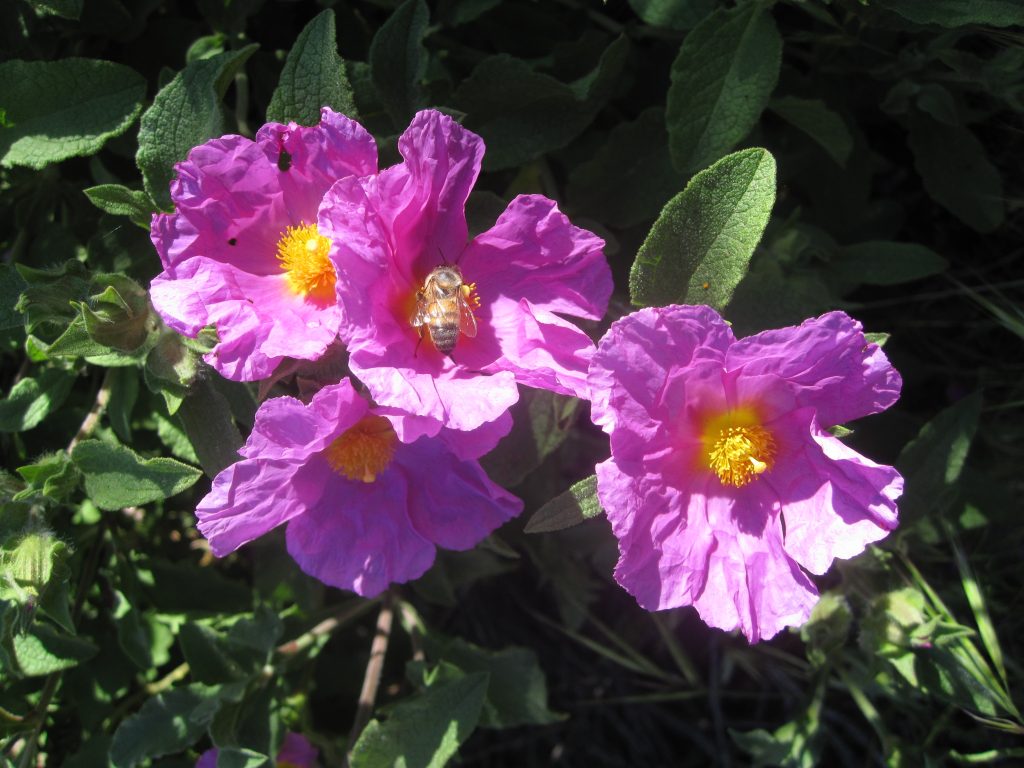
Where and when to find it. Pink Rockrose is not native to California, but it’s a handsome ornamental — and, like so many ornamentals, it can drift from neighborhoods into wilder landscapes. Not surprisingly, these escapees center around urban areas, where exotic ornamentals are common, especially the Bay Area and the stretch from L.A. to San Diego. Crimson-spot Rockrose, however, is largely restricted to the Los Angeles area. Only Pink Rockrose occurs in Cherry Canyon, where the Descanso Fire Road takes a sharp switchback as it leaves a low spot near Descanso Gardens. Look for either species of Cistus from February or March into June.
- For more about flowers in the genus Cistus, visit Wikipedia.
- For distribution maps, taxonomy, and more photos, visit Calflora.org.
- You can also read other wildflower notes, or check out the LCF wildflower directory.
