
Occasional observations on the wildflowers of 91011.
Golf is sometimes teasingly described as “a good walk, spoiled,” but walks can be spoiled in other ways, too. Like by discovering that a nasty invasive shrub has silently run rampant right next to Cherry Canyon for ten or twenty years, wholly unchecked. That was my experience in May of 2025, when I spotted a mass of bright yellow blossoms outside the western fence of Descanso Gardens, only to find a huge infestation of a tenacious intruder: Canary Islands St. Johnswort (Hypericum canariense). Yep, that was truly one. lousy. walk.
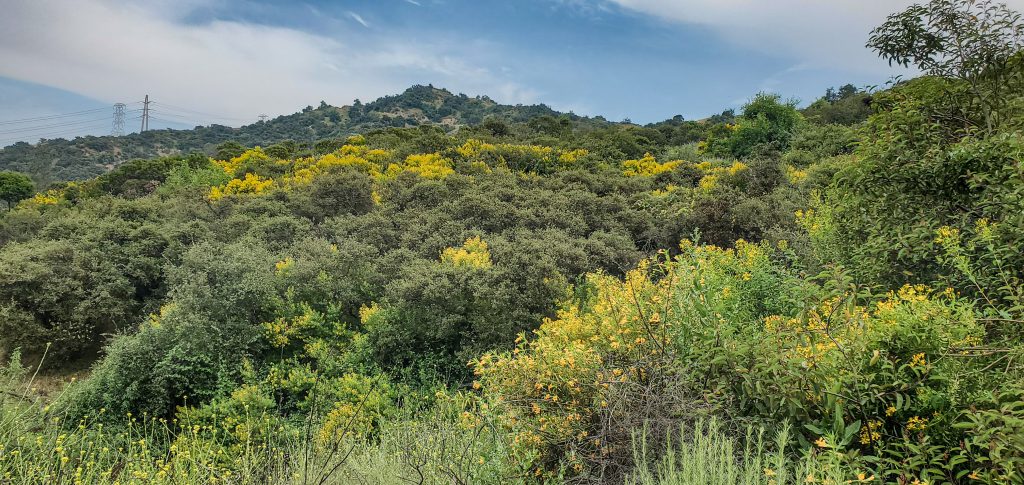
By many accounts, Canary Islands St. Johnswort — which actually does originate from the Canary Islands — is an attractive ornamental shrub. Its yellow blossoms are vibrant and eye-catching, which is how I spotted it at a distance of nearly a quarter mile. Each stem can host up to 30 flowers, and each of those seed capsules (which turn brown and remain on the plant) will disperse hundreds of tiny seeds. And that’s a problem. This shrub is a prolific spreader, and it has often escaped captivity.

But there’s another problem. Canary Islands St. Johnswort can reach 15 feet in height, with a lateral spread that is wider still. Essentially, it swallows and displaces all other vegetation, with the exception of taller trees. The resulting loss of native species compromises the survival of important native insects and even small mammals. Once established, Canary Islands St. Johnswort can constitute over 90% of the canopy, and can spread up to a hundred feet per year if the conditions are right.
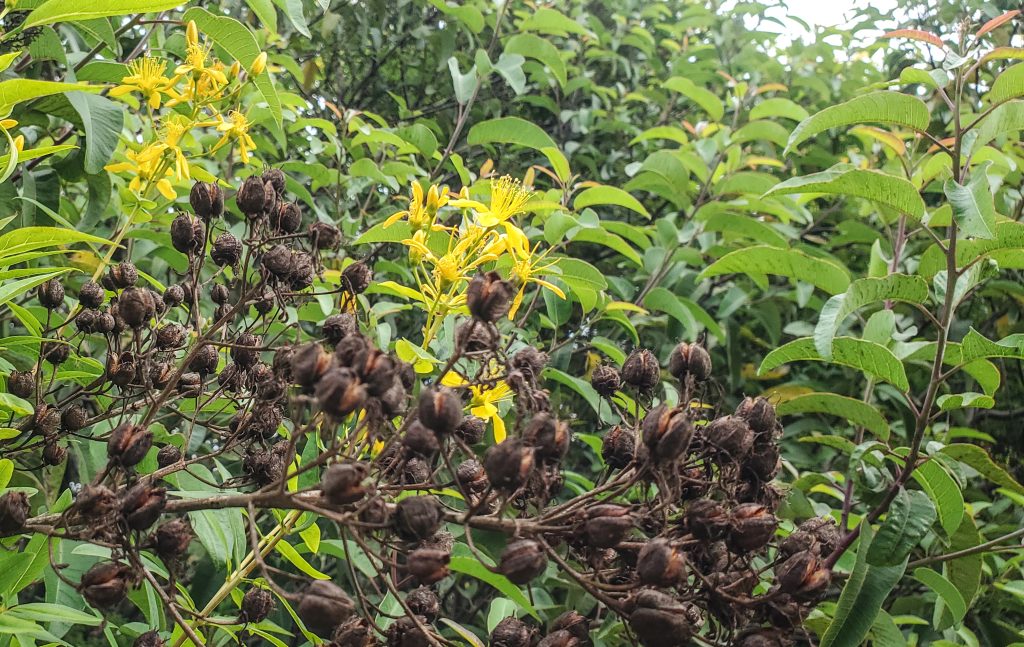
Eradicating this invader (or even containing it) requires immense effort. Often, heavy machinery is needed to attack these densely woody shrubs. The dormant seed bank then needs to be monitored for several subsequent years. And the price tag for eliminating a large infestation could easily run to six figures, maybe more.
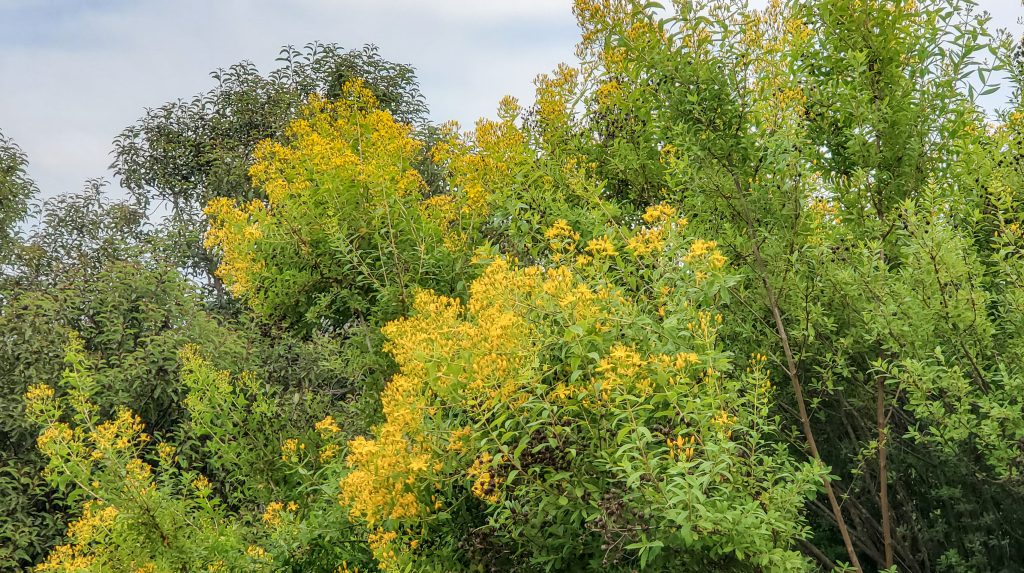
You can see why encountering this voracious plant with the pretty blossoms could spoil anyone’s walk — much as a nightmare can spoil a good night’s sleep! If there’s any upside, it’s that this infestation is not likely to remain unchecked for much longer. Plans to begin controlling this invader are in the works at Descanso Gardens, and this infestation is now firmly on the radar screen of the Pest Management Division of the Los Angeles County Agricultural Commissioner as well as the collaborative L.A. County Weed Management Area. Stay tuned!
Where and when to find it. Canary Islands St. Johnswort has been introduced as an ornamental shrub to many Mediterranean climates worldwide, especially Australia and South Africa. As non-native ornamentals often do, it has escaped and proliferated. In this manner it has taken root in several coastal areas of California, with particularly large infestations in coastal San Mateo County and at Laguna Canyon. Our local instance (unusual for occurring further inland) straddles the western fenceline of Descanso Gardens and can be observed from the Friendship Path as well as from lower sections of the Descanso Fire Road. It blooms as early as April or as late as June.
- For more about Canary Islands St. Johnswort, visit Wikipedia.
- For controlling Hypericum canariense, visit the Calif. Invasive Plant Council.
- For distribution maps, taxonomy, and more photos, visit Calflora.org.
- You can also read other wildflower notes, or check out the LCF wildflower directory.
