
Occasional observations on the wildflowers of 91011.
Midsummer usually brings stultifying weather — think July and August, whew! — and the heat turns our hillsides a discouraging brown. Nothin’ to see here, move along. . . . But take a closer look! If you do, you’ll discover that we have a handful of flowers, mostly of modest size and appearance, that seem to love the toastiest parts of summer.

One such flower is California Sandaster (Corethrogyne filaginifolia), a species that is capable of remarkable variations in the color of its flowers and the shape of its leaves. It can appear as a single tall stalk, or as a dense tangle of interwoven branching stems, or as an utterly prostrate ground-covering mat.

But it’s fairly predictable in a few other respects. First of all, it’s an aster. That means that it will usually look like a daisy, with a dense center surrounded by many petals. Here, we need a brief botany lesson: The “petals” on an aster are actually individual flowers and are more precisely ray flowers. That dense center? It’s actually a bundle of individual flowers, called disk flowers. One California Sandaster blossom can have 40 or more ray flowers as well as over 120 disk flowers. Like me, you may have thought you were looking at just one flower, when really you were seeing a composite of 150 flowers or more — which gives it a lot of reproductive firepower later on, when the seeds appear as a bundle of flyaway bristles!
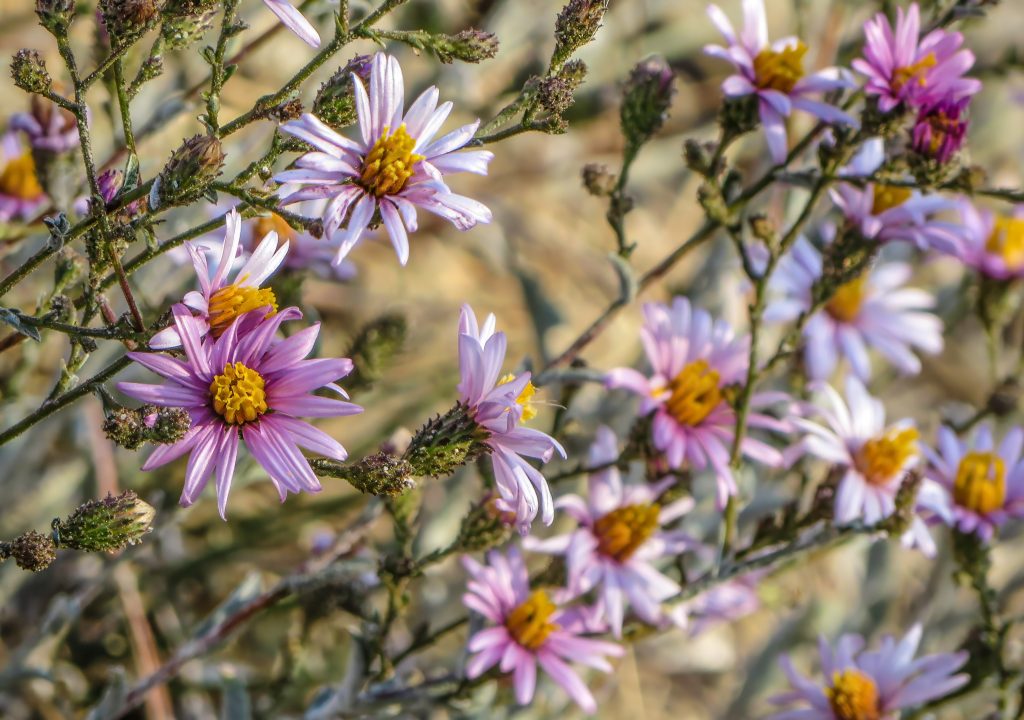
Back to the visuals. The “petals” of California Sandasters range from white or pink to shades of light or dark purple. But the center of the flower is reliably a rich yellow, and those disk flowers are remarkably tall — meaning that the yellow center is not a flat button but more like a bundle of tiny yellow tubes.

Another good field mark is the base of the flower, which forms an inverted cone on which scale-like structures peel back on themselves. They look barbed, but they aren’t really sharp. In fact, this part of the flower almost mimics a pineapple, minus the leaves at the top. We have a few other flowers with similar features, but none that have purplish petals.

California Sandasters have long been cultivated to make them look less unkempt. Backyard gardeners are especially fond of cultivars like “Silver Carpet Aster,” which grows as a low or draping mat of pale pink flowers and silver-green leaves. It’s lovely! But if you do plant any varieties or cultivars of Corethrogyne in your yard, remember: they like it hot! Summer watering can be fatal to them.

Where and when to find it. California Sandaster is common along the entire California coast and on the edges of the San Joaquin Valley. It also flourishes further inland from the Bay Area south to the Mexican border and beyond. It’s easy to find along many of our roads, particularly the upper sections of both the Forest Hill and Descanso Fire Roads. Locally, it blooms most reliably beginning in July, but its blossoms can continue to recur not only through the summer but even into December. Indeed, look close: even stalks and stems that are brown and dried up may still be displaying delicate purple asters!
- For more about California Sandaster, visit Wikipedia.
- For info about growing Corethrogyne filaginifolia in your yard, visit Calscape.org.
- For distribution maps, taxonomy, and more photos, visit Calflora.org.
- You can also read other wildflower notes, or check out the LCF wildflower directory.
