
Occasional observations on the wildflowers of 91011.
“Ornamentals” can go bad, and here’s a good example: Tree Tobacco (Nicotiana glauca). Introduced two centuries ago as a landscape ornamental, this invasive South American species can appear as a straggly shrub or as a spindly tree that can surpass 20 feet tall. It’s easy to identify, not only by the bluish-gray-green leaves and stalks, but also by its massive clusters of tubular yellow flowers. To be sure, hummingbirds love this flower — but that’s a problem, too, because their fondness for Tree Tobacco can lure them away from pollinating native flowers that also evolved to rely on hummers.
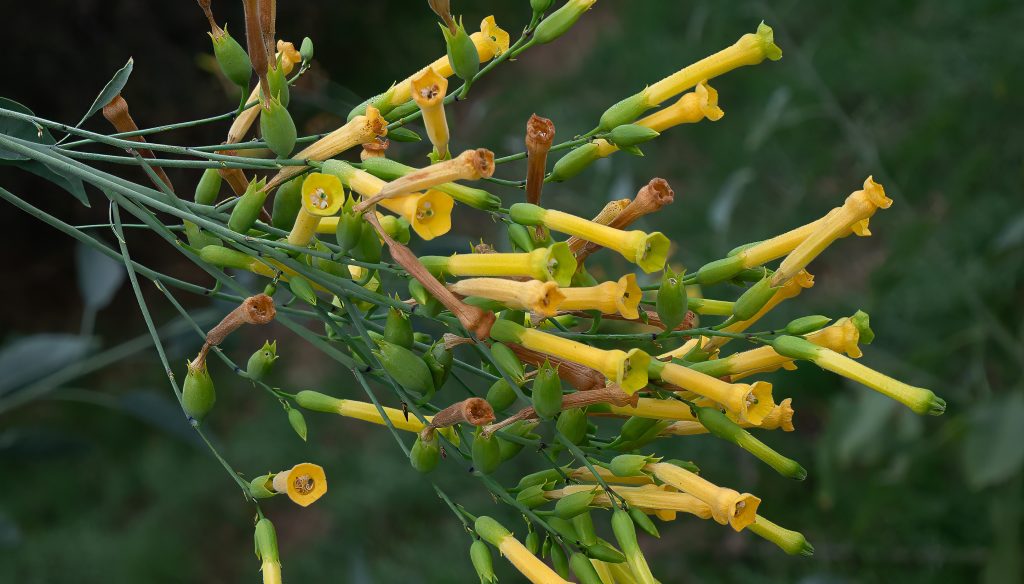
But is it really tobacco? Um, barely? First of all, you need to know that every part of this plant is toxic to ingest, whether you’re a human or livestock. Some sources report that there is actually NO nicotine in this species, only a similar but more toxic alkaloid, anabasine, which can lead to cardiac arrest or fetal deformities. Native Americans did not eat this plant, but they did use it as a poultice and for ritual smoking — though it must be remembered that this particular Nicotiana species is a relatively recent arrival.
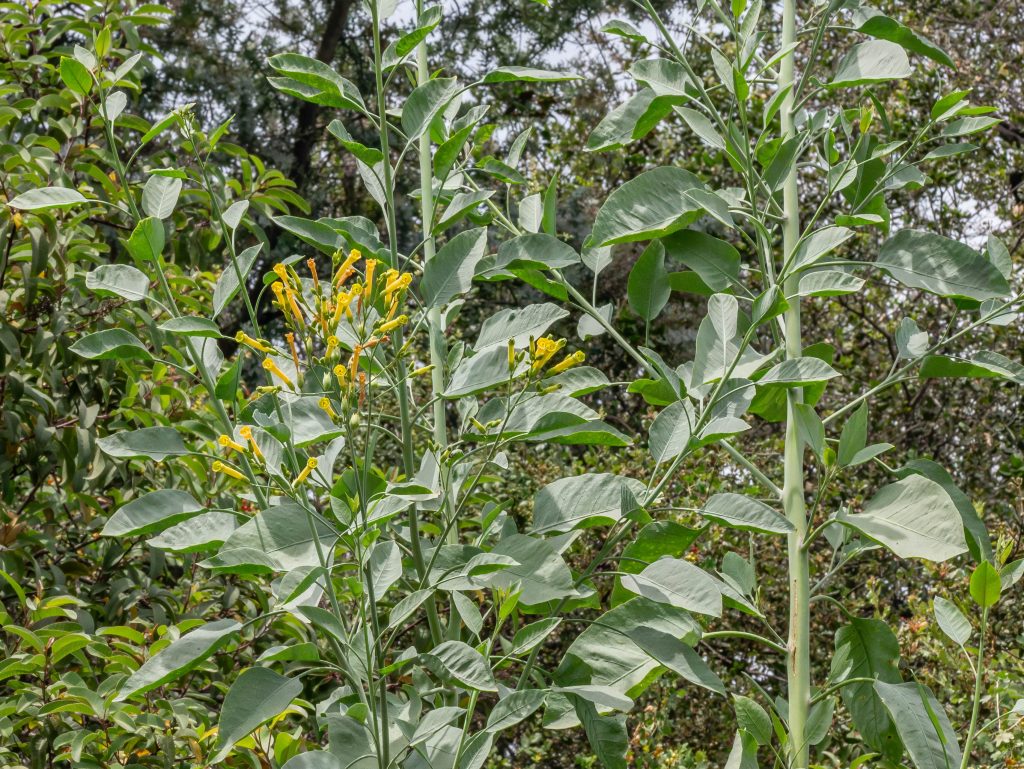
In fact, California hosts nine species of Nicotiana. Four of these are native wildflowers, all marked by a much smaller stature and by tubular white flowers that often form a lovely star at the end. (One of these, N. quadrivalvis, a.k.a. Indian Tobacco, occurs on the Friendship Path.) Of the other five non-native species, only Tree Tobacco is regarded as an invasive.

Tree Tobacco is thus a mediocre, obnoxious, and risky (!) substitute for cultivated tobacco (Nicotiana tabacum). Not only does it out-compete native species, it also poisons the nearby soil with its secretion of anabasine — a toxin that you may absorb if you handle this plant without wearing gloves. Discouragingly, one tree can produce up to a million seeds per year, and these seeds are generally quite viable. It also resprouts vigorously: the photo below, with some stalks up to 10 feet tall, was taken near the bottom of the Forest Hill Fire Road, barely four months after these plants had been cut flush to the ground.
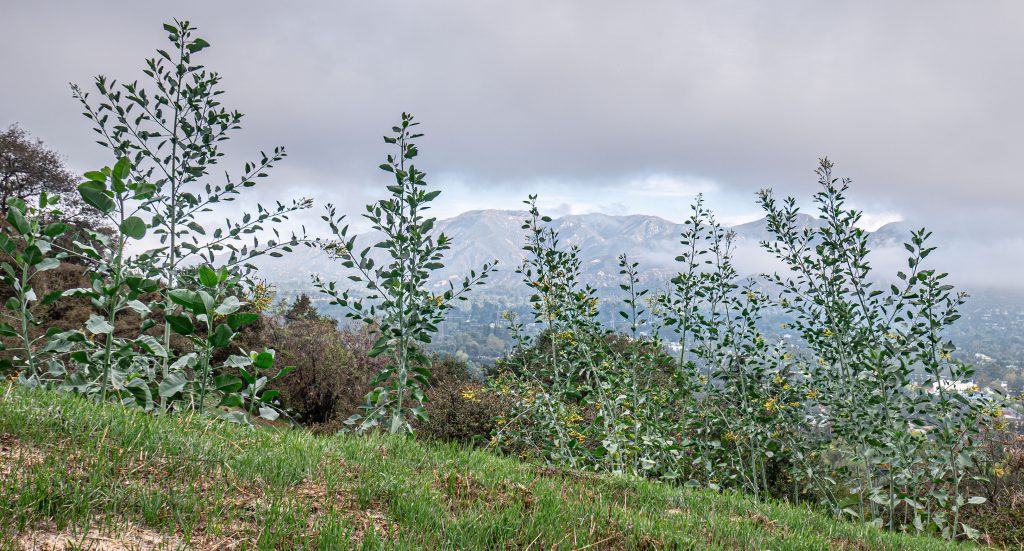
But wait, there’s hope! Although Tree Tobacco is found in many places at Cherry Canyon, the actual number of plants is not yet overwhelming. In other words, this is a battle that might be worth fighting. Indeed, during the fall of 2026, volunteers from a local Scout troop will be mapping Tree Tobacco in Cherry Canyon with the aim of removing as much of it as possible during the coming rainy season. This project has support from the La Cañada Trails Council as well as from Descanso Gardens and some local businesses. If you’d like to contribute to projects like this one or even get involved, use the sign-up links at the bottom of this page.
When and where to find it. Tree Tobacco blooms from March (or earlier) through September (or later!). It’s a worldwide invasive, occurring not only in South America, but also in much of Mexico, southern Africa, southern Australia, and much of the Mediterranean. In California, it’s found in the central valleys and in coastal counties from the Bay Area to San Diego. It loves Southern California! You can easily find it around the basin above Devil’s Gate Dam and along many roads and trails in La Cañada. The flanks of Mt. Lukens have a number of stands of this plant, as does Cherry Canyon — though we hope that will change!
- For more about Tree Tobacco, visit Wikipedia.
- For info about controlling this invasive, visit the Cal-IPC website.
- For info about Nicotiana species suitable for your yard, visit Calscape.org.
- For distribution maps, taxonomy, and more photos, visit Calflora.org.
- You can also read other wildflower notes, or check out the LCF wildflower directory.
