
Occasional observations on the wildflowers of 91011.
Not many people look forward to chance encounters with scorpions. So when we hear that some wildflower has “scorpion weed” listed among its common names, we might back away from it. Better safe than sorry, right? But this one is complicated! The name “scorpion weed” is applied seemingly at random to almost any of the species in the genus Phacelia — and there are well over 100 species of Phacelia in California! They are all at least moderately attractive, but some are simply gorgeous, particularly this one: Wild Canterbury Bells (Phacelia minor), which is fairly rare at Cherry Canyon but regularly occurs along the Open Space Trail.

Though many varieties of Phacelia look like small shrubs, they’re actually annuals. Canterbury Bells has broad roundish leaves and a fairly upright stem — so it looks like, well, like a typical garden flower. But like all other Phacelias, it emerges with a coiled spiral stem that gradually uncurls through the blooming period. The blossoms are all on the outside of the spiral, and they open one-by-one until the last, innermost blossom opens on the now-straightened stalk. And it’s this uncurling spiral that lends the name “scorpion weed” to Phacelia minor, as well as virtually all other Phacelias.
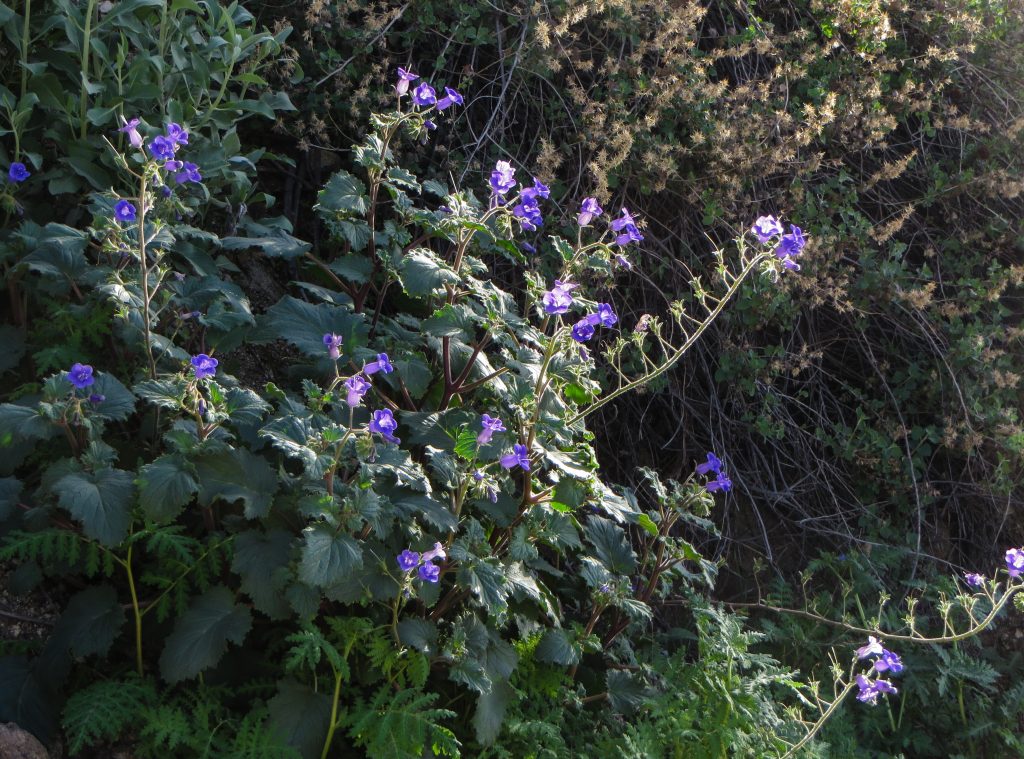
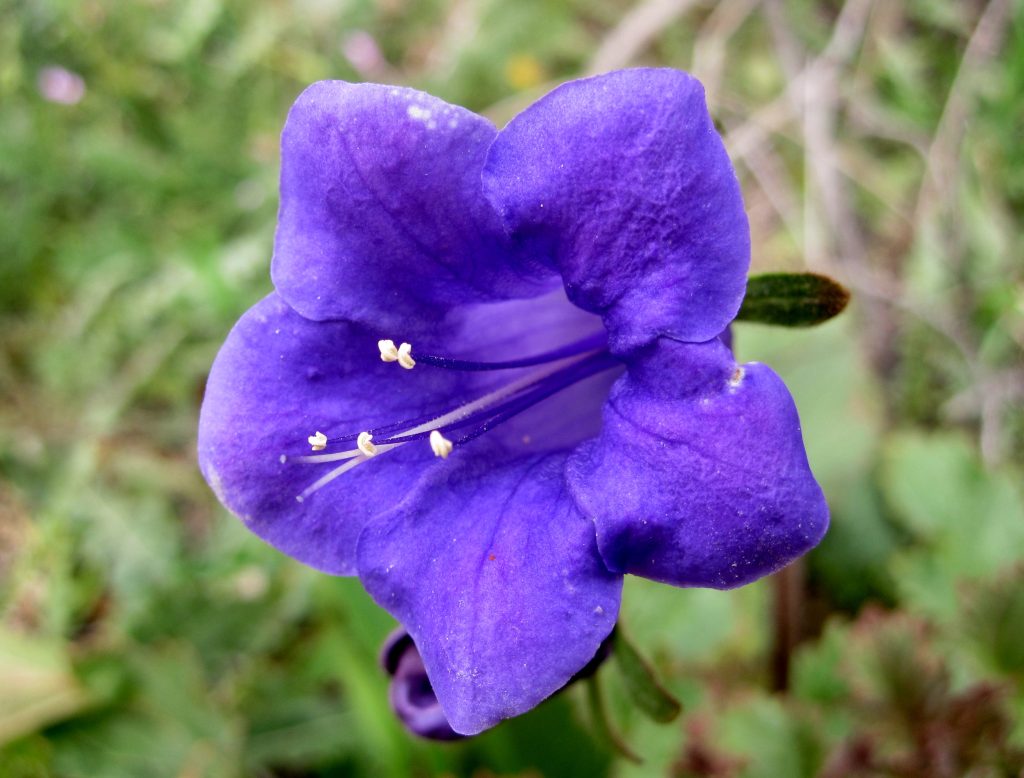
Phacelias come in many colors, from blue to white or even yellow, but Canterbury Bells are one of only four California species that produce incredibly purple or deep blue bells — and on P. minor, the bells are very deep, distinguished by a slight constriction at the throat. The leaves are also worth your attention: they have deep veins that are sometimes tinged with red or orange, as are the leaves’ crinkly edges. This flower is a real looker!
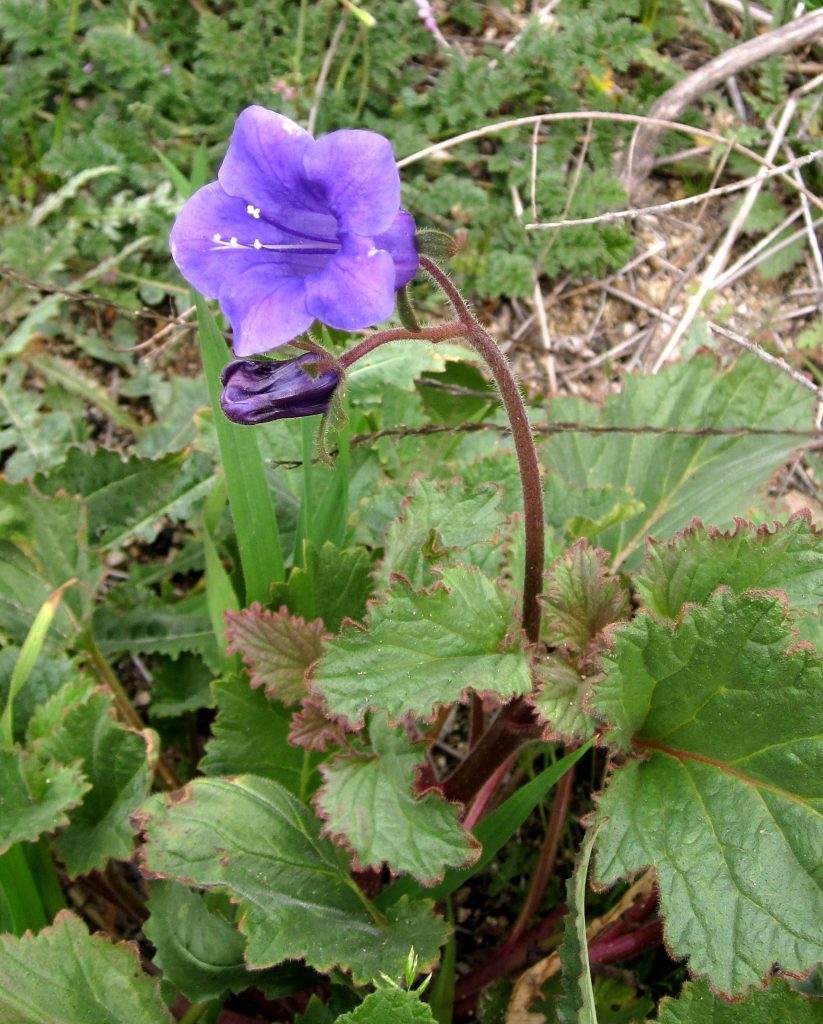
Canterbury Bells share one other “scorpion” trait with their three purple cousins, and you should pay close attention here! Unlike most Phacelias, the four purple or blue “bell” species are widely known to cause contact dermatitis, just like Poison Oak. The leaves are quite resinous and even pleasantly scented, but that resin can trigger a spectacular outbreak of skin blisters. (Ask me how I know!) Happily, though, and unlike actual scorpions, Canterbury Bells don’t have an attitude. They won’t chase you. They won’t crawl into your shoes. But they are guaranteed to brighten your day!
Where and when to find them. Around La Cañada, half a dozen Phacelia species are often seen, especially if you hike around the Devils Gate reservoir and the nearby arroyo, or higher up on Mt. Lukens. Cherry Canyon, however, has only three, of which Canterbury Bells are the rarest. Moreover, because they’re annuals, there’s never a guarantee they’ll return next spring. In recent years they’ve been seen on the upper Cerro Negro Trail as well as along the upper Cherry Canyon Fire Road. The higher sections of the Open Space Trail, along the flanks of Mt. Lukens, are more reliable — though after a wildfire, they may be everywhere! Surprisingly, there is also a small but robust colony of Canterbury Bells just a mile SE of Cerro Negro, on the uphill side of Figueroa Street, 0.4 mile south of where it splits off from Chevy Chase Drive. As for timing, Canterbury Bells is the earliest of our Phacelias, blooming in February or even January, and potentially lingering into early May.
- For more about Canterbury Bells, visit Wikipedia.
- For information about growing Phacelia minor in your yard, visit Calscape.org.
- For distribution maps, taxonomy, and more photos, visit Calflora.org.
- You can also read other wildflower notes, or check out the LCF wildflower directory.
