
Occasional observations on the wildflowers of 91011.
How many rare plants are there at Cherry Canyon? Wait, is that a trick question? How do you even know if a plant is rare? Well, in fact, over fifty years ago the California Native Plant Society prepared an inventory of all the native plants in California that deserved to be regarded — and protected! — as rare, and they also developed a scale to rank just how rare any one of these rare plants is, so that the most vulnerable could also receive the most protection.
So, to answer the question: three. There are three plants found at Cherry Canyon that appear on the CNPS inventory, all of them ranked at 4.2, meaning they are plants of limited distribution that are moderately threatened. Two of them are trees: Southern California Black Walnut and the Engelmann Oak. Only one is a flower, and it is truly, truly, drop-dead gorgeous: Plummer’s Mariposa Lily (Calochortus plummerae).
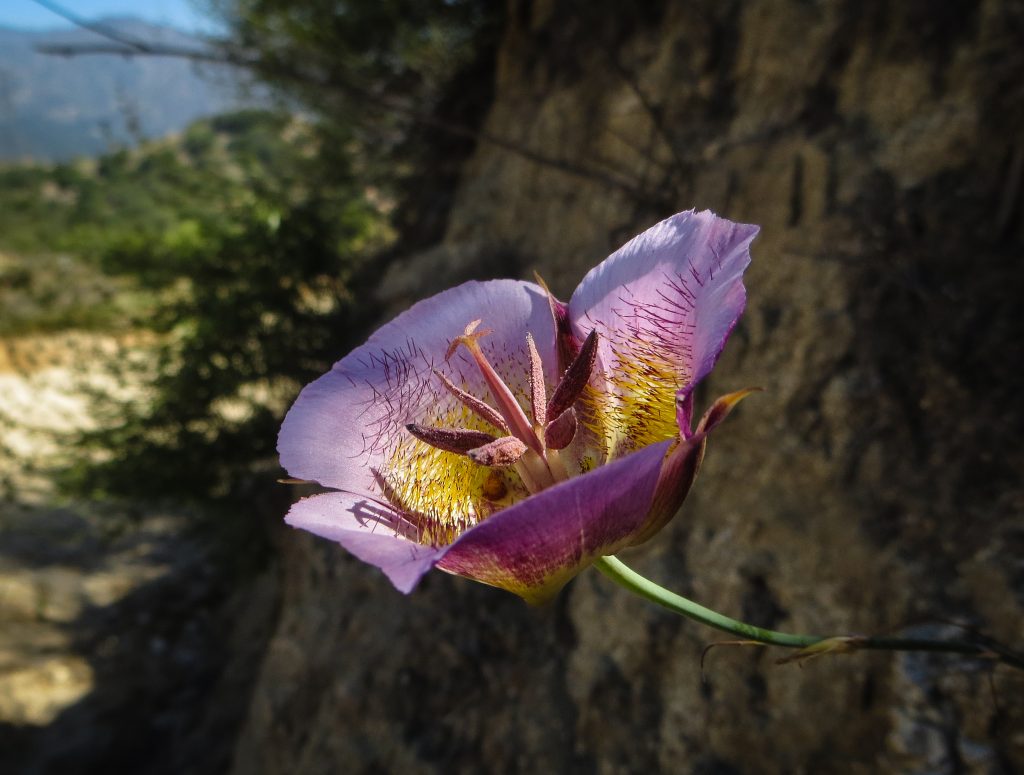
Plummer’s Mariposa produces one of the largest individual blossoms in our local hills, surpassed in size only by Jimsonweed (Datura wrightii). Its blossom is also, surely, one of the most fascinating. Its petals can vary from whitish lavender to rose pink to deep purple. The middle third of its petals is covered by dark-tipped yellowish hairs, while the lowest part of the petal can range from white to streaky red. Hidden within the hairs is a roundish depression known as a nectary — a gland that offers pollinators a nectar reward. From the outside, the blossom can appear to be banded in yellow and purple, or rose, or pale lilac. The variability of this flower only adds to its fascination and beauty.

But for all its beauty, it’s nonetheless a fragile flower, and far from abundant. Mariposa seeds can take seven years to develop into a bulb that bears actual flowers, and the stems themselves are long and easily broken. In our area, Plummer’s Mariposas tend to favor inhospitable roadcuts with mediocre, rock-hard soil. Even more frustrating to their admirers, they often fail to bloom every year, especially if the rainfall is weak. Instead, they will produce a single, slender leaf that nurses the plant’s developing bulb though a drought year — though, ironically, too much summer rain will rot and kill that same bulb!
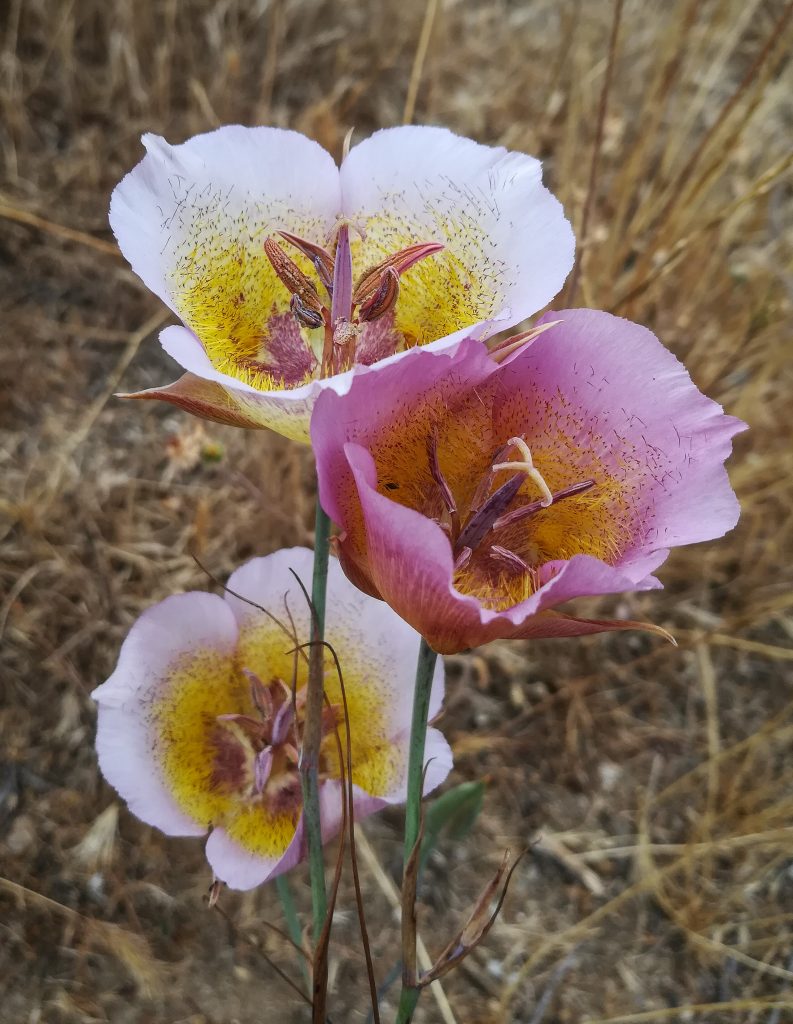
When and where to find it. Plummer’s Mariposa is rarely found before Memorial Day and is usually gone well before the first of July. It’s found from the Santa Monica Mtns. on the west, across the San Gabriels and San Bernardinos to the east, and then south into the San Jacinto Mtns. That’s it! Plummer’s Mariposas are one of So.Cal.’s exclusive treasures. At Cherry Canyon, it has been seen in as many as a dozen locations, though in many cases these observations were of but a single plant, and of these, many have been seen only every few years. Sometimes they peek out from the protective foliage of other plants! But if you start at the Forest Hill entrance and hike the road to the Cerro Negro Lookout, you’ll pass almost every reported location, so keep an eye on the uphill margins of the road. And if you find one, hold your breath and give thanks: you’re in the presence of the rarest of the rare, and the fairest of the fair.

- For more about Plummer’s Mariposa, visit Wikipedia.
- For information about growing Calochortus plummerae in your yard, visit Calscape.org.
- For distribution maps, taxonomy, and more photos, visit Calflora.org.
- You can also read (or subscribe to) other occasional notes on the wildflowers of 91011.
