
Occasional observations on the wildflowers of 91011.
There are many vines that thrive in chaparral, though we don’t always notice that they are, in fact, vines and not shrubs. A prime example of a plant with just such an identity crisis is our local native honeysuckle — Lonicera subspicata, Southern Honeysuckle. California actually hosts seven species of native honeysuckle, of which two are reasonably common in our area: Chaparral Honeysuckle (L. interrupta), which is more common a bit higher in the San Gabriels; and Southern Honeysuckle, which is what you’ll find in our foothills and at Cherry Canyon.

More often than not, our impressions of honeysuckle derive from the climbing and weaving vines of Japanese Honeysuckle (L. japonica), with its fragrant yellow and white blossoms. Japanese Honeysuckle is one of only four non-native honeysuckles in California, and the only one that is at all widespread — and sometimes an invasive pest. But if you think all honeysuckles act like Japanese Honeysuckle, you’d be mistaken. Southern Honeysuckle is quite capable of vining and climbing its way upwards, using other shrubs or trees as a support. But it can also thrive out in the open, and if there is nothing to climb on, it will produce unkempt sprays of branches that form a sizeable mound — proof positive that in its heart of hearts, it wants to be a shrub. (If you plant it in your yard, keep its unruliness in mind, because it really doesn’t train to a trellis!)
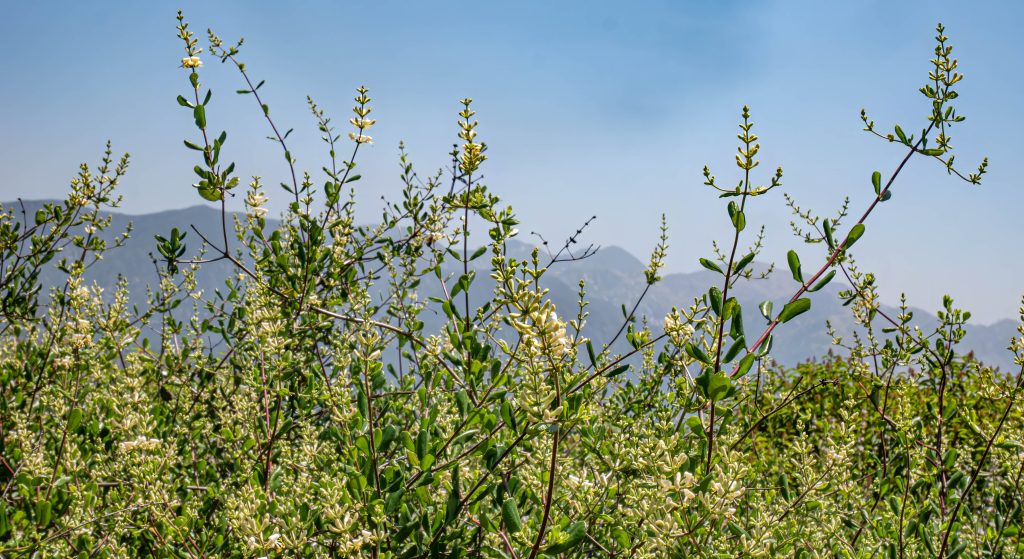
Although not noticeably fragrant, Southern Honeysuckle has other virtues. Dozens of creamy flowers appear as a spike at the end of its slender branches, set off by protruding stamens with yellow pollen. The youngest stems are green, but the adjacent parts of the stems are frequently an almost metallic burgundy, shiny but with very fine hairs. These colorful stems are a good way to recognize Southern Honeysuckle even when the blossoms are gone!

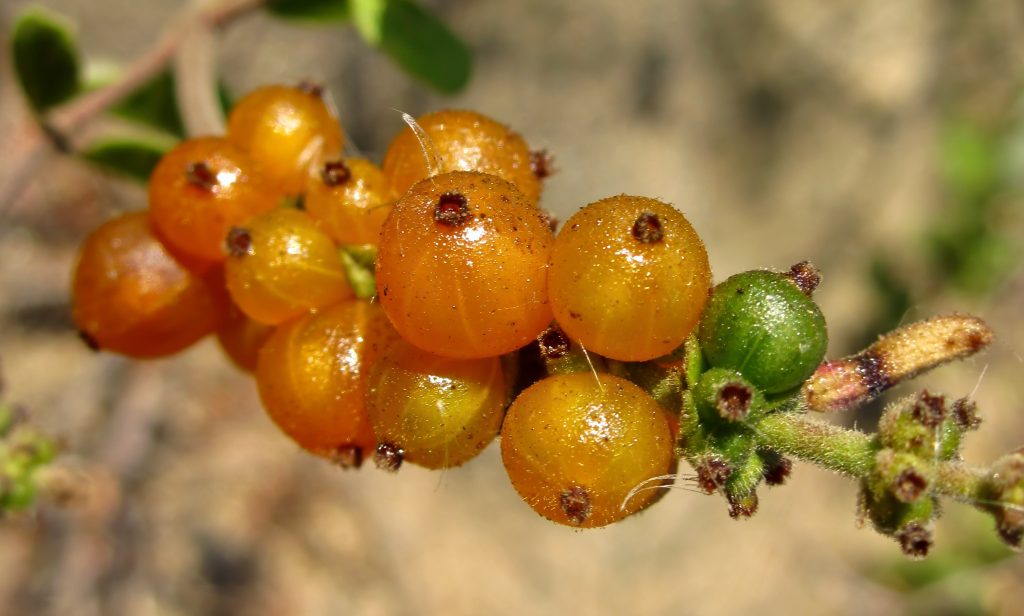
Equally charming, the flowers produce not dry seedpods but translucent golden or red berries. These beautiful berries are reportedly (!) edible but very bitter. Given that many honeysuckle species are toxic to humans, it’s probably best to enjoy the berries only with your eyes — unless you’re a mockingbird or a finch.
Where and when to find it. Southern Honeysuckle flourishes in coastal counties from the Bay Area to Baja California. Locally, it’s common in chaparral as well as on the slopes of oak woodlands. Check along the Forest Hill Fire Road and Liz’s Loop, but you’ll also find it above Devil’s Gate Dam along the eastern trail, as well as further up Arroyo Seco. Statewide, it blooms from March through August, but April through June are the best months around here.
- For more about Southern Honeysuckle, visit Wikipedia.
- For info about growing Lonicera subspicata in your yard, visit Calscape.org.
- For distribution maps, taxonomy, and more photos, visit Calflora.org.
- You can also read other wildflower notes, or check out the LCF wildflower directory.
