
Occasional observations on the wildflowers of 91011.
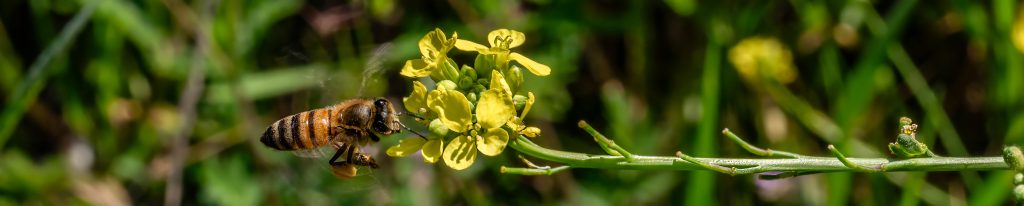
Somewhere in Southern California, perhaps along some freeway, you’ve surely seen those impressive springtime swaths of yellow mustard in bloom. Such a bright and cheery yellow, it’s easy to admire! The legend, known to many California school children, is that early Franciscan friars brought mustard seeds from Spain, using the vivid blooms to make their missions and roads visible from far away. Clever idea! But disastrous results: today, “wild” mustard pops up everywhere, with over a dozen invasive species in Los Angeles County alone.

Cherry Canyon and our local hills are not immune, but around here you’re most likely to run across only three of those invasive species:
- Black mustard (Brassica nigra), the original Franciscan variety
- Field or “Common” Mustard (Brassica rapa), from which many types of vegetables have been derived
- Mediterranean or “Shortpod” Mustard (Hirschfeldia incana)
Black Mustard is the largest, growing up to 8′ tall, with dense infestations in the Santa Monica Mtns. and Chino Hills. But Cherry Canyon is plagued much more by Shortpod Mustard, a more compact species that crowds the fire roads and especially the Sister Cities Friendship Path and the Cerro Negro Trail — at least, until it surrenders to the brush-clearing efforts of the county trail crew.
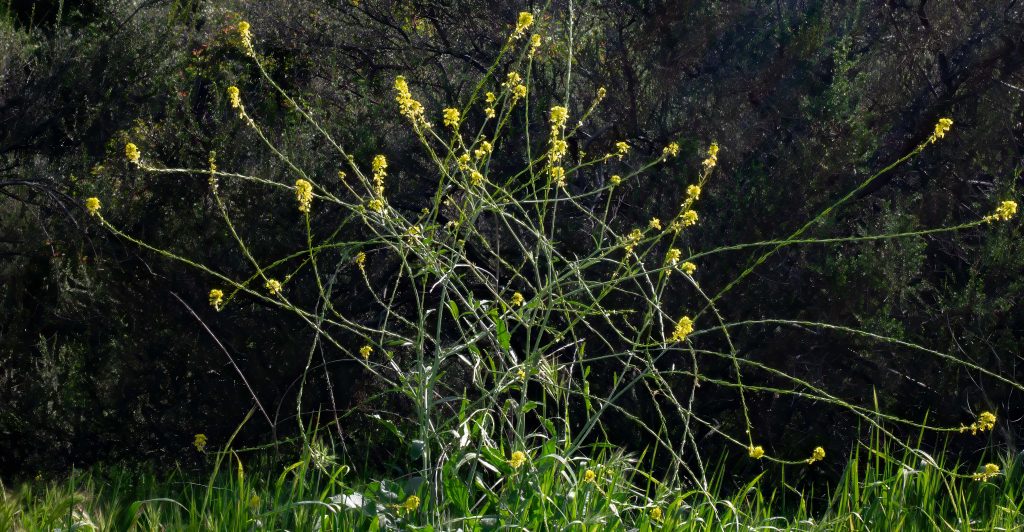
Shortpod Mustard and Black Mustard are quite similar, but Black Mustard always has an obvious central stem with an abundance of branches and foliage, while Shortpod Mustard is a much smaller plant. Black Mustard has black seeds, by the way (the source of its name), while Shortpod Mustard has (wait for it . . .) short seedpods with reddish-brown seeds. You can glimpse those seedpods on the photo above: they’re like short fir-tree needles, barely a centimeter long, and plastered close to the main stem.

It’s pretty, isn’t it? So what’s not to like? Well, actually, a lot. Mustard plants are adept at colonizing areas disturbed by cultivation or fire, or even by pulling up the plants themselves. They crowd out native flowers, sometime creating a “monoculture” where mustard — and only mustard — survives. Ironically, even as mustard species flourish after a wildfire, these plants are themselves highly combustible when they’ve dried, fueling the next wildfire and leading to a cycle of succession from which the original native wildflowers may never recover.

Where and when to find it. As noted, Shortpod Mustard loves disturbed soil. So watch for it along any road or fire road, as well as any trail that receives a fair amount of sunlight, including portions of the Cerro Negro Trail and the newer Sister Cities Friendship Path. Statewide, it can bloom year ’round, but it’s generally in bloom in our area from early spring through early summer, at which time its dried stalks will continue to stand indefinitely.
- For more about Shortpod Mustard, visit Wikipedia.
- For information about controlling Hirschfeldia, visit the Calif. Invasive Plant Council.
- For distribution maps, taxonomy, and more photos, visit Calflora.org.
- You can also read other wildflower notes, or check out the LCF wildflower directory.
