
Occasional observations on the wildflowers of 91011.
Now that you’ve mastered Lupine 101 (haven’t you?), let’s look at another of our local lupines: Collar Lupine (Lupinus truncatus), a modest but lovely lupine found in our foothills. You might be worried (as Lupine 101 warned) that identifying lupine sometimes requires tweezers and a magnifying glass, but Collar Lupine is actually quite user-friendly!

One of the best clues is embedded in the name — or, really, in the leaves. The Latin truncatus calls attention to the way that the leaves of this species are uniquely truncated, as if someone took scissors and snipped off just the tip of the more rounded leaves found on other lupines. The effect is unmistakable. The common name, “collar” or “collared,” points to the same feature, though not as clearly. Evidently, some think its flat “star” of blunted leaves resembles the ornate ruffed collars worn by the well-to-do in Elizabethan England. You needn’t agree, but if you find yourself looking at an asterisk of squared-off leaves, you’re surely looking at Collar Lupine.
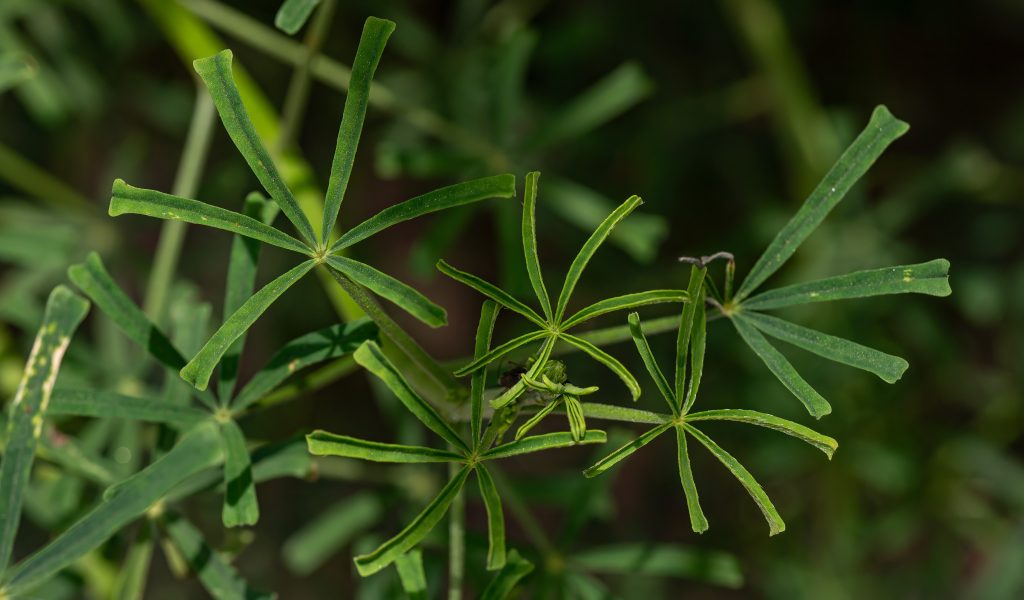
There’s another telltale feature, too: the blossoms are attached in a raceme, which means that individual blossoms sort of stagger up the stalk, sparsely, one by one — unlike Arroyo Lupine, where the blossoms are arranged on the stalk in whorls, with many blossoms at the same level, creating multiple blossom-rings. Also, the blossoms are themselves a standout: they begin with the purple-and-white that typifies most lupines, but as they age, the blossoms of Collar Lupine turn a ravishing magenta, not to be missed!
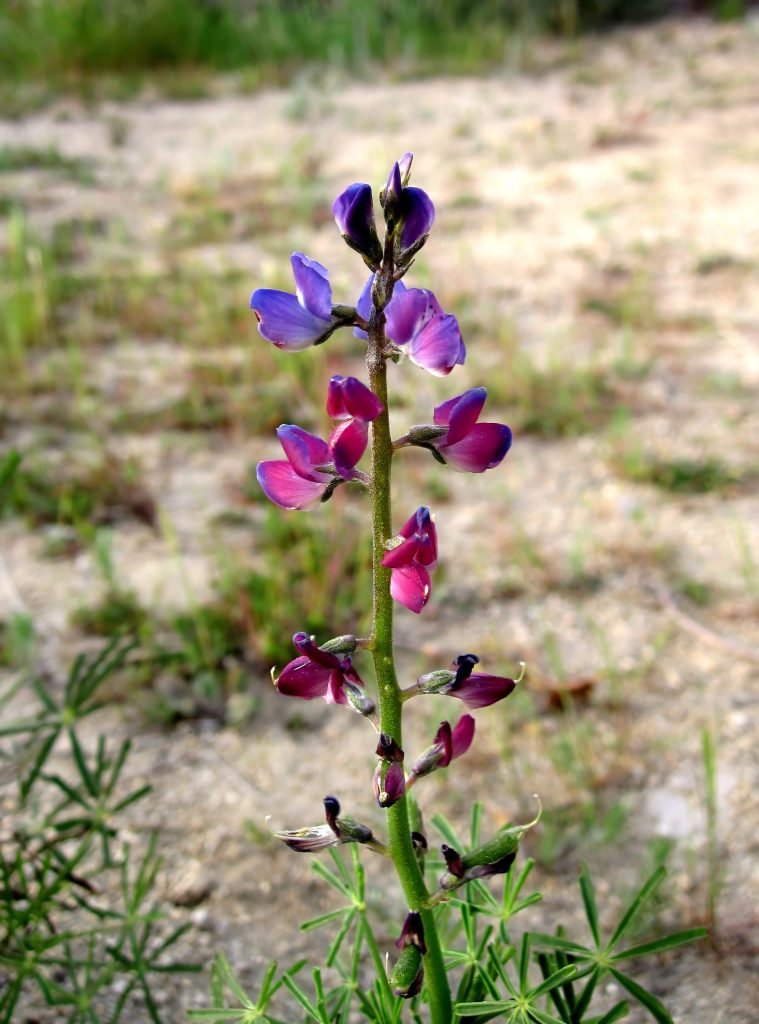
When and where to find it. Collar Lupine blooms from March into May in coastal hills and foothills, ranging from Monterey to the Mexico border. (Locally, of course, it may bloom a month earlier.) Because its blossoms are not as dense or showy as Arroyo Lupine, it can be harder to spot, but it’s regularly seen on the margins of all the fire roads that lead away from Five Points, as well as along the upper Open Space Trail.
- For more about Collar Lupine, visit Wikipedia.
(And here’s more on ruffed Elizabethan collars!) - For information about growing Lupinus truncatus in your yard, visit Calscape.org.
- For distribution maps, taxonomy, and more photos, visit Calflora.org.
- You can also read other wildflower notes, or check out the LCF wildflower directory.
