
Occasional observations on the wildflowers of 91011.
One of the loveliest collections of flowers that you’ll find in California is gathered in the genus Linanthus (which translates loosely as “flax flower”) — a collection of small but bright gems, usually in shades of white or pink. All these species are beautiful, but most have (in my opinion) boring names — with two exceptions! One of these is called “Evening Snow,” a delicate white desert flower that blooms only at dusk. Its name calls to mind snowflakes gently drifting down as the day comes to an end. So poetic! The other is a flower found in our local hills. Its name is vastly different, as is its character: “Prickly Phlox.”

Okay, so “prickly” may not be the best marketing slogan to get you to come and see this flower, but it is, at least, truth in advertising! Prickly Phlox (Linanthus californicus) is assuredly a gorgeous pink flower. It can bloom in twos and threes, but it can also carpet a square yard or more with colors that range from palest pink to deep rose.

Then there’s the leaves. So odd! Like something you might expect to see while snorkeling: long and slender stems that radiate countless short and pointy — yes, even prickly — leaves. You might well call them needles, but they’re a far cry from cactus spines. Reach your hand into this plant and you’ll probably decide to pull it back, but it’s quite unlikely that you’ll be bleeding. These leaves are a vibrant green, but in some cases they turn bright red — possibly from heat stress, but regardless of the reason, it just adds to the loveliness.
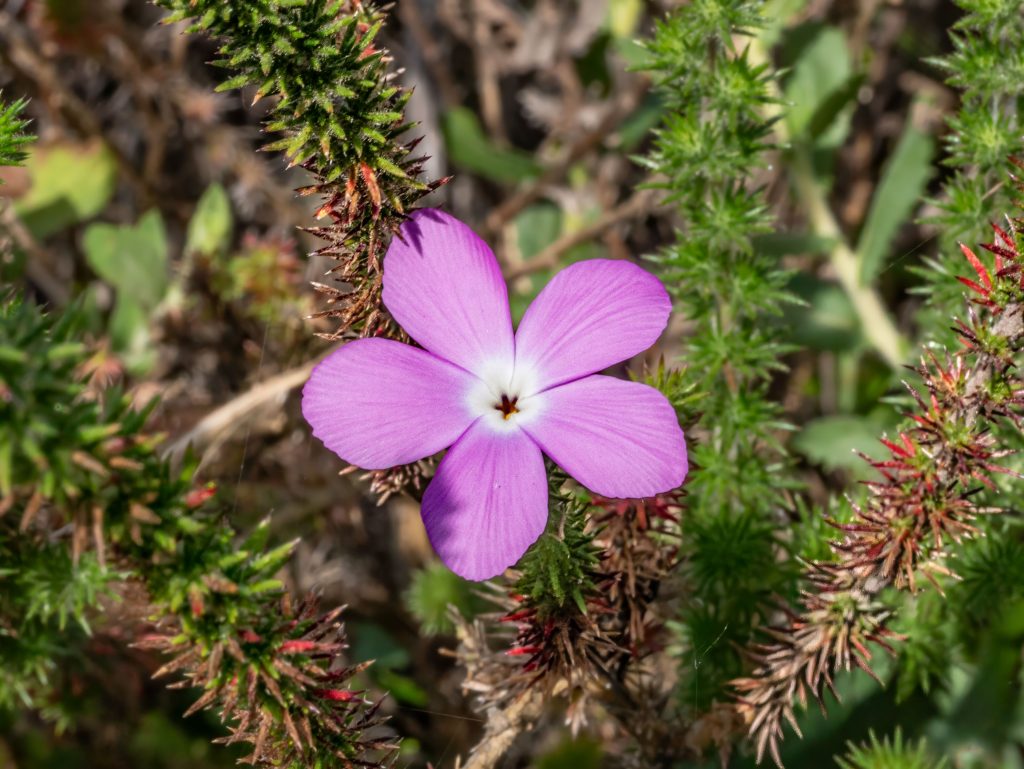
Let’s go back to those blossoms. If you find this flower, do keep your hands to yourself, but by all means look into the throat of the flower as deeply as you dare. The base of each petal is generally white, in contrast to the bold pink you see elsewhere. But up close, you’ll see that the “claw” or base of each petal has a tiny but distinct notch. The effect is to frame the flower’s throat with a well-defined five-point star, and the throat itself (where the reproductive organs are well hidden) often appears as a rich red or yellow color — sort of a star within a star!
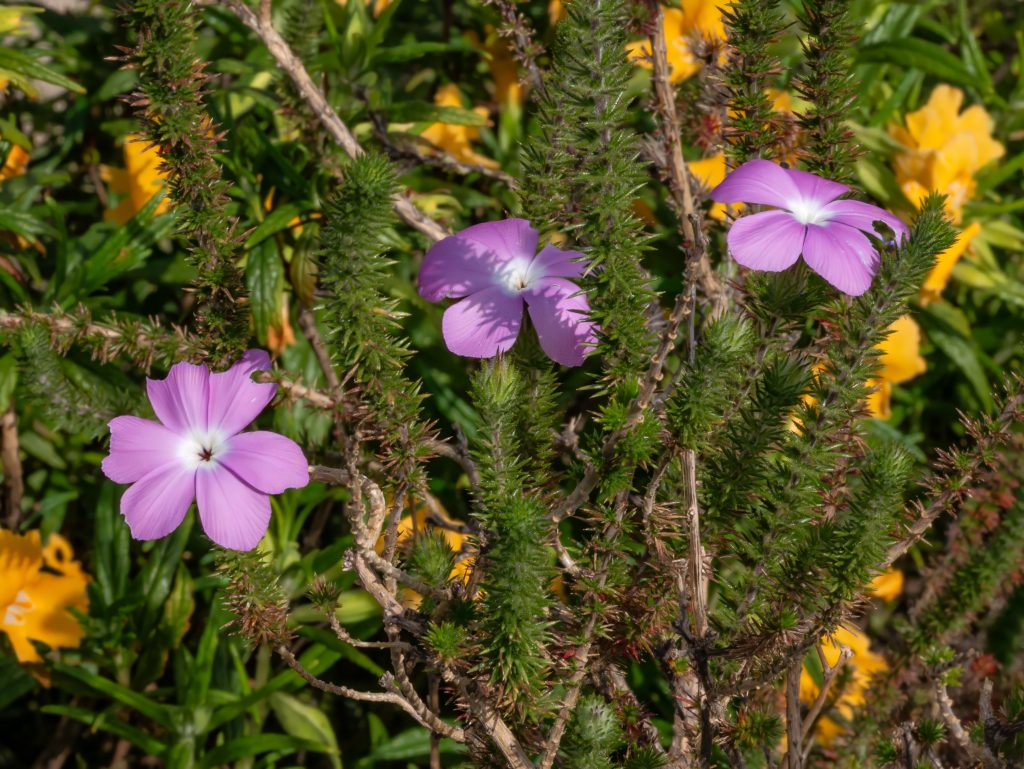
On the left, an unusual blossom with six petals, not five — and a six-pointed star!
Where and when to find it. Prickly Phlox grows in only five or six of California’s coastal counties, from San Luis Obispo to Riverside. It occurs in coastal dunes, chaparral, and even in mountain openings, as high as 6500 feet. Locally, it’s not especially common. There is an enduring patch near the south end of the Descanso Fire Road, right behind the firing range for the Glendale Police Dept., and there’s at least one patch on the Open Space Trail above Harter Lane. The best local trail, though, is the Gould Mesa Fire Road, which runs about a mile from the Angeles Crest Highway (where it leaves our city limits) and descends 500 feet to Gould Mesa Campground. Along this steep road, you may see in excess of two dozen plants on the uphill embankments! Elsewhere, check the Sunset Ridge Fire Road over in Altadena, or many of the higher trails in the San Gabriels. Statewide, it blooms from February to August, but you’re most likely to find it around here from April into June.
- For more about the Linanthus genus, visit Wikipedia.
- For info about growing Linanthus californica in your yard, visit Calscape.org.
- For distribution maps, taxonomy, and more photos, visit Calflora.org.
- You can also read other wildflower notes, or check out the LCF wildflower directory.
