
Occasional observations on the wildflowers of 91011.
It’s actually not that much fun to be the wet blanket — in this case, to criticize a pretty flower just because it doesn’t belong in our wild areas. But y’know, even if it’s a dirty job, someone’s gotta do it. So here’s my kvetch about vetch.

Hairy Vetch (Vicia villosa) is robust member of the pea family that hails from Europe and western Asia. Unlike the many non-native species that are planted as ornamentals and then escape, Vicia villosa is cultivated in this country for forage and fodder, as well as a cover crop. It is notably adept at enhancing soil nitrogen. And, you will surely have noticed, it sports some undeniably attractive flowers in hues of white and reddish-purple.
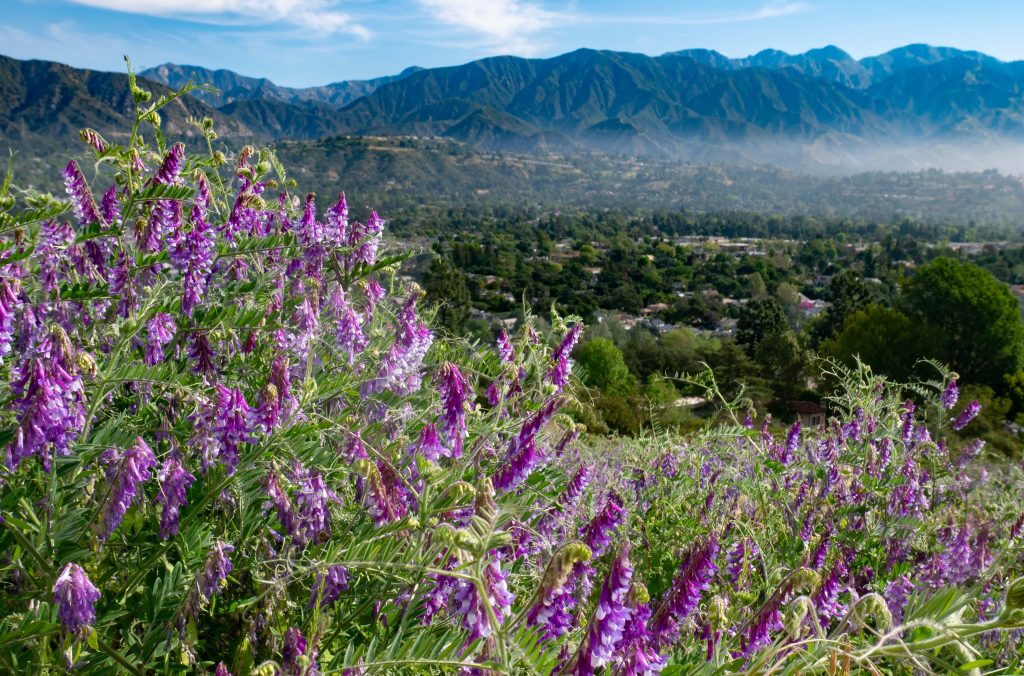
As a typical pea plant, those purple-and-white blossoms have the basic three-part anatomy found also on lupines and sweet peas: a banner, two wings, and a keel. But in the case of Hairy Vetch, the tube of the blossom is quite elongated, which gives this flower a very distinctive look — especially when you notice how all of those blossoms are attached in a tight row along only one side of the stem. Those stems are also obviously hairy, as the common name would suggest, even as the Latin villosa means “shaggy.”

Hairy Vetch can be a useful crop. But it can also be a pest, even in agricultural areas. It is certainly a pest in our wild areas, because it can grow not only by sprawling but also by climbing. At Cherry Canyon, you can find it densely covering an open meadow as well as clinging to nearby shrubs and even shrouding them. Later, when summer heat arrives, it will quickly wither, leaving its brown and shriveled vines in place, having “stolen” springtime’s milder sunshine from our less aggressive native flowers. So when it’s in bloom, it’s undeniably a pretty flower! But it’s not at all good at sharing.
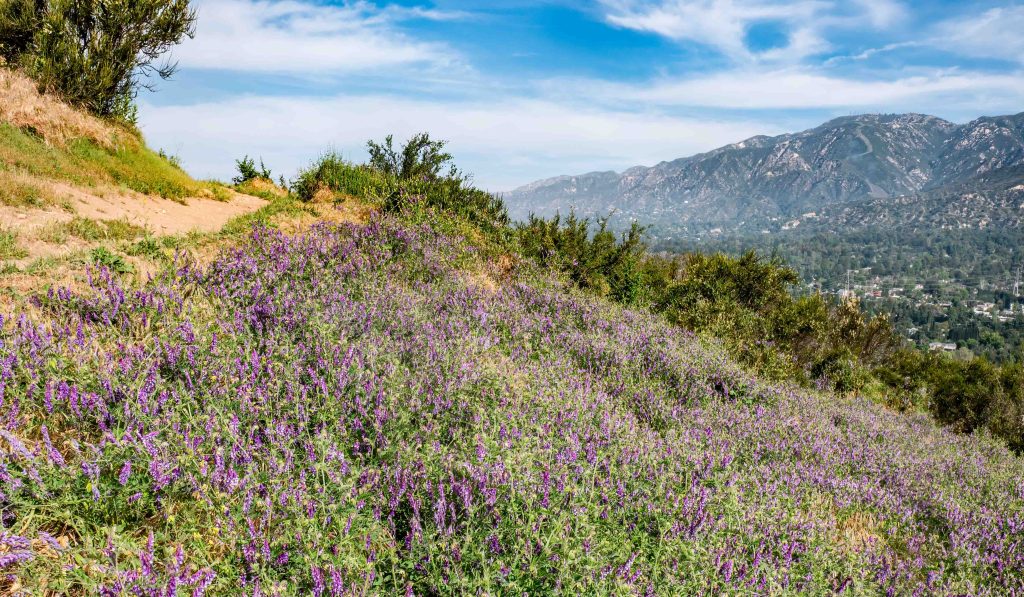
Where and when to find it. Hairy Vetch occurs in all the 48 lower states, and many states regard it as an invasive pest. Curiously, California does not, even though locally it is assuredly invasive. It flourishes especially in the Sacramento Valley, the Bay Area, and all the coastal counties of Southern California. Hairy Vetch is especially thick along some of the upper sections of Liz’s Loop and the lower section of the Forest Hill Fire Road, but it can sometimes appear along our city trails. It’s also found inside the southeast perimeter of Descanso Gardens above Hope’s Garden. Look for it to bloom from February into May.
- For more about Hairy Vetch, visit Wikipedia.
- For distribution maps, taxonomy, and more photos, visit Calflora.org.
- You can also read other wildflower notes, or check out the LCF wildflower directory.
