
Occasional observations on the wildflowers of 91011.
It’s a safe bet that you won’t have to leave your neighborhood, or even your own yard, to see this lovely and horrible wildflower: the highly invasive Bermuda Buttercup (Oxalis pes-caprae). Native to South Africa, it was deliberately introduced to California about a hundred years ago as an attractive ornamental. Bermuda Buttercup now plagues not only California but also Chile, Australia, the Mediterranean, and even Japan. It’s also a pest in Bermuda, where it was introduced in the late 1800s — but, ironically, it’s endangered in South Africa! Oh, and did you know, it also thrives in Cherry Canyon?

Some homeowners love — love! — this plant, and they either cultivate it or let it run wild in their yards. Truly, it is an ornamental, and arguably the showiest of the genus that you’re likely to see in California (where only 6 of our 17 Oxalis species are natives). Honestly, it’s just as well that these homeowners love Bermuda Buttercup, because once you’ve got it, you’re stuck with it.

And that’s why many gardeners, botanists, and environmentalists hate — hate! — this plant: it’s an ordeal to eradicate. Its taproot can extend 18″ into the soil, where it churns out bulbs and bulblets that easily break off if you pull it up by the root. It does not spread by seed because, technically, it’s sterile. No matter: it spreads all the same by underground threads that can produce bulbs at some distance from the taproot. Also, gophers are fond of the bulblets and have been observed carrying them off to stash (where else?) underground. Removing a colony of these flowers entails deep excavation and soil-sifting to remove all the bulblets — a nearly hopeless task that you’ll probably need to repeat for three seasons or more.
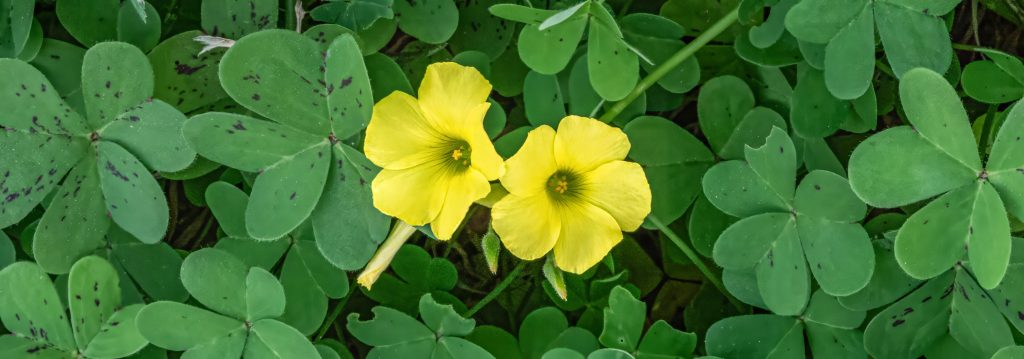
If only it weren’t so darn pretty! The bright yellow flowers open by day and close by night, and they are relatively large. Dense strips or colonies in bloom offer a striking and cheery sight. The shamrock-like leaves are also handsome, though the Latin pes-caprae actually compares the shape of each leaflet to the more or less heart-shaped hoof of a nanny goat. (The photo below has imposed a sketch of that hoof on one of the leaflets; note that leaves often display the purple spots seen here.) Another name detail: oxalis comes from a Greek word meaning “sour,” and while Bermuda Buttercup can be toxic to humans and livestock if consumed in quantity, some people enjoy its tangy taste, which derives from the oxalic acid in its leaves and stems.

The downside is what you’d expect: Oxalis pes-caprae is all-too-successful at invading the landscape. It takes over. It creates a monoculture that out-competes native wildflowers and discourages native birds and other animals, including the hawks, owls, foxes, and coyotes that feed on smaller species that forage among the native plants. And, at the end of the day, we’re probably stuck with it.
Where and when to find it. Bermuda Buttercups are rampant in the coastal hills of California, from Sonoma County to San Diego, but they favor disturbed soil — like roadsides. Statewide, they usually bloom from December through June. You’ll find them in La Cañada along many of our streets and trails, as well as in countless yards. They flourish along nearby sections of the Angeles Crest Highway as well as in the Arroyo Seco. At Cherry Canyon, there are significant infestations where the Conservancy Trail meets the Forest Hill Fire Road.
- For more about Bermuda Buttercup, visit Wikipedia.
- For more on controlling this pest, visit the Calif. Invasive Plant Council.
- For distribution maps, taxonomy, and more photos, visit Calflora.org.
- You can also read other wildflower notes, or check out the LCF wildflower directory.
