
Occasional observations on the wildflowers of 91011.
Although “I don’t get no respect!” was the tagline of the late comedian Rodney Dangerfield, it might well have been spoken also by an exceedingly common native wildflower — California Buckwheat (Eriogonum fasciculatum). Buckwheat is a shrub that blooms for at least six months of every year (though you might find it in bloom in almost any month), and that “success” probably accounts for why it’s taken for granted: if you see it everywhere and almost almost year ’round, you may actually not see it at all.
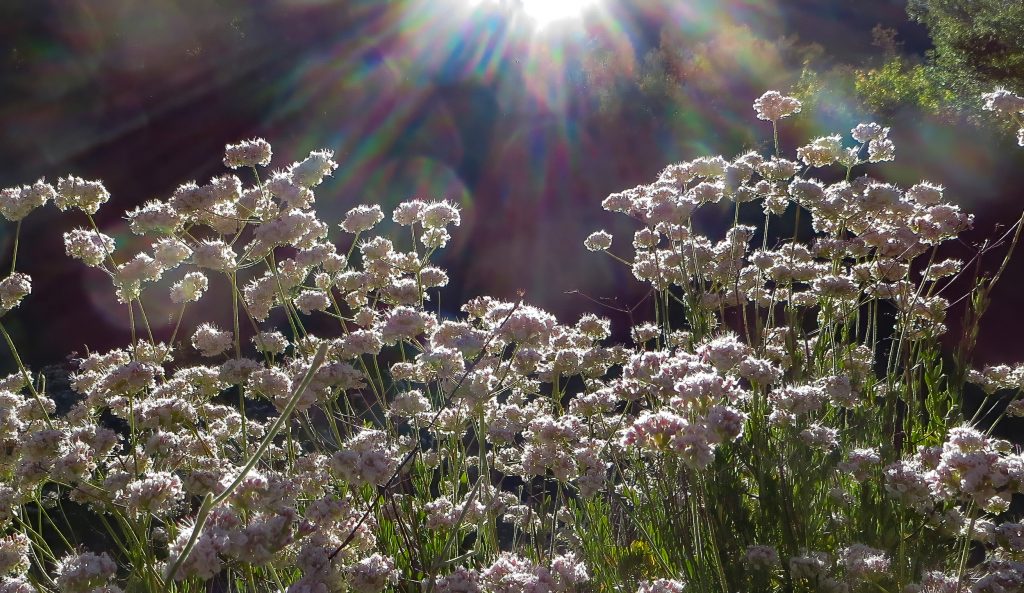
From a distance, California Buckwheat is a nondescript dark green shrub with nondescript white blossoms. In the late summer and fall, those white blossoms turn rusty brown, which some people may find unattractive. Plus, the individual blossoms are so small, eh, why bother looking at them?
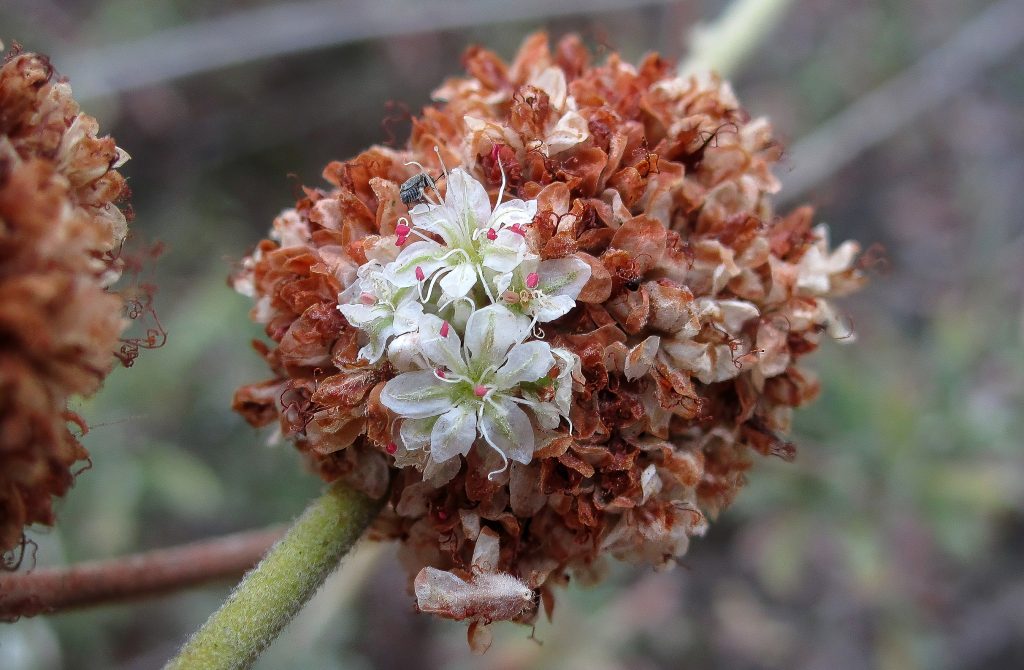
Why bother? Really? Take another look — and have another think! Even if you fail to see the attraction of its clusters of small blossoms, California Buckwheat has a lot going on! Its flowers play a big role in the production of native honey and are a favorite of several species of butterfly. Native Americans have used it for medicinal tea and also as a food source. Drought tolerant, it plays a role in erosion control and fire recovery. Oh, but the flowers?
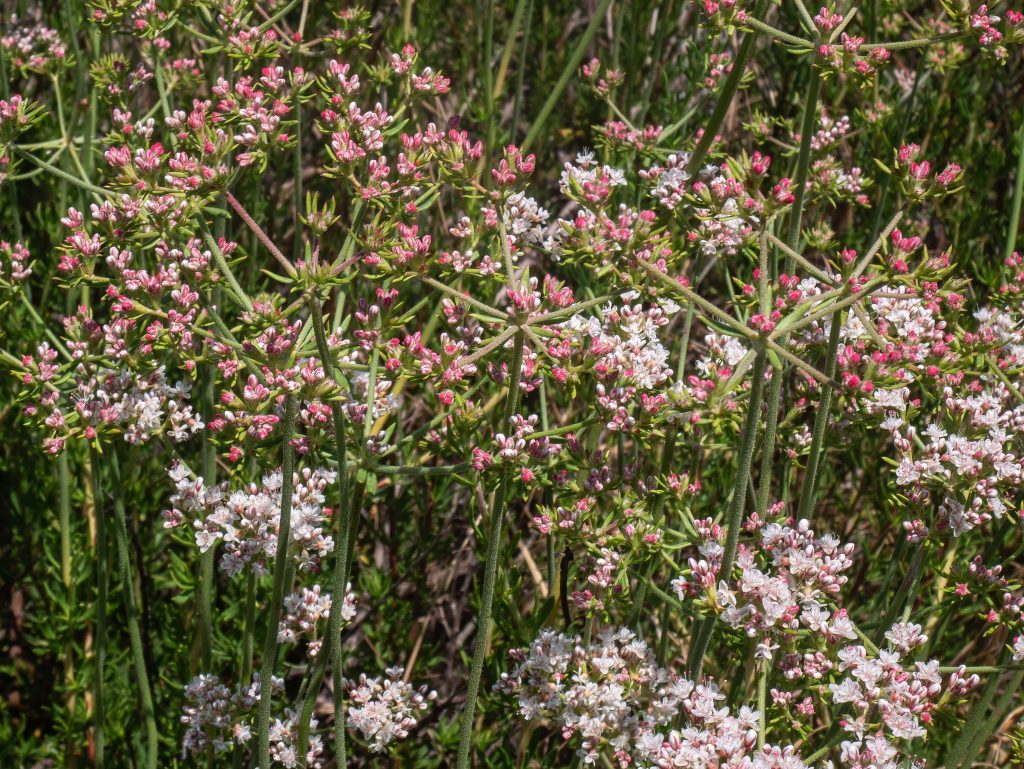
Yes, the flowers! You really need to push your face into this plant to see something of the color and complexity of its blossoms. Each pom-pom starts as a cluster of forty or fifty buds that call to mind red-and-white candy canes. They go on to become tiny white and pink bridal bouquets, eventually fading to a handsome, warm rust color — still retaining their original shape and size. The leaves are short and needle-like. The stems are woody, but the plant can be small and wispy or can form a thicket of shrubs waist-high, or higher.

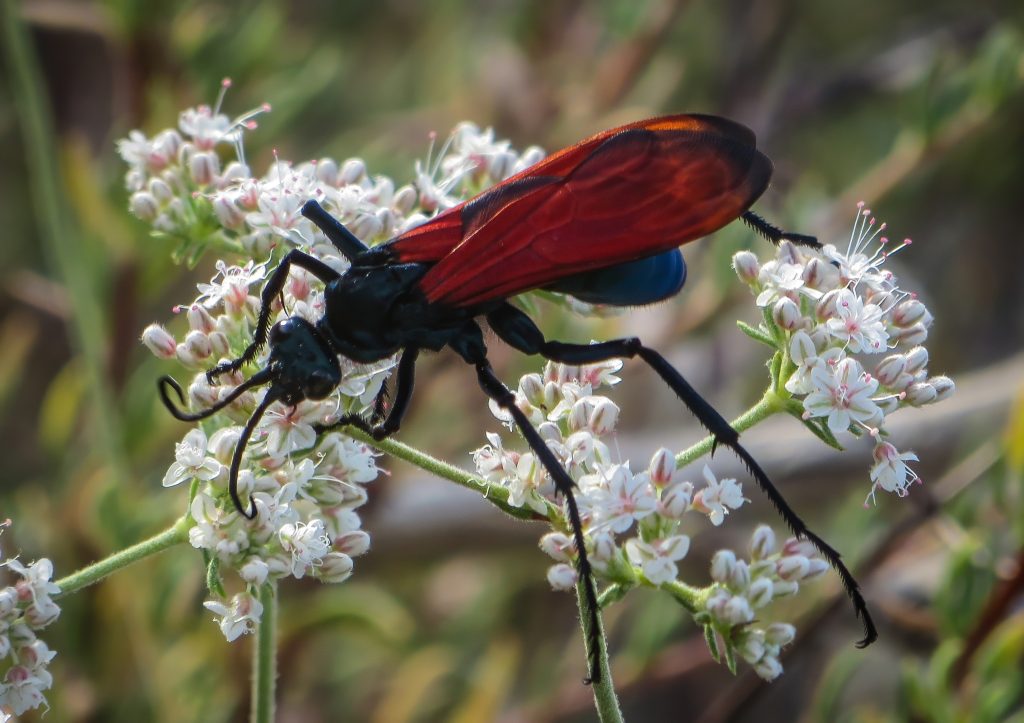
If you still haven’t come to respect California Buckwheat, we’ll have to call in The Enforcer. Seriously! It’s not just bees and butterflies that love this plant — its nectar is also a fave of one of the most amazing wasps in North America, namely, the Tarantula Hawk (Pepsis sp.). This wasp — my family knows it as the T-Hawk — measures 2″ to 3″ long, with up to a 4″ wingspan. It’s famous for cruising over the chaparral during the day, looking to paralyze an unwary tarantula with its venomous stinger, then lay an egg on it. When the larva hatches, it will bore into the still-living tarantula, eating it from the inside. (Now that’s a bedtime story!) With wings of copper, body of black, this is one beautiful wasp. It is also capable, you may wish to know, of delivering the second-most painful sting of any insect in the entire world. Fortunately, it’s not aggressive. But if you’re not inclined to respect the beauty of California Buckwheat, maybe you should think about who its friends are!
Where and when to find it. California Buckwheat is native to almost the entire American southwest, and it is especially common in all the coastal counties of California from Sonoma County south, as well as the inland counties of Inyo, Kern, San Bernardino, and Riverside. You can find it throughout the Verdugos and San Gabriels, as well as along almost every trail in La Cañada, where it blooms throughout the spring and summer.
- For more about California Buckwheat, visit Wikipedia.
- You do want to know more about Tarantula Hawks now, don’t you??
- For information about growing Eriogonum fasciculatum in your yard, visit Calscape.org.
- For distribution maps, taxonomy, and more photos, visit Calflora.org.
- You can also read other wildflower notes, or check out the LCF wildflower directory.
