
Occasional observations on the wildflowers of 91011.
Some wildflowers are masters of balance. They float above the ground on improbably thin stalks, seemingly indifferent to their fragile support, concerned to do only one thing well: shine. Common Woodland Star (Lithophragma affine) is one of these floral acrobats.

“Common” Woodland Star? Oh, if only it really were common! Granted, this species is scattered over all the coastal counties of California, as well as in the foothills of the Central Valley, but however much these dainty flowers adorn a hillside, their presence always remains subtle. Locally, even though Woodland Star is a perennial, it doesn’t show up every year — only if conditions, including rainfall, are favorable.
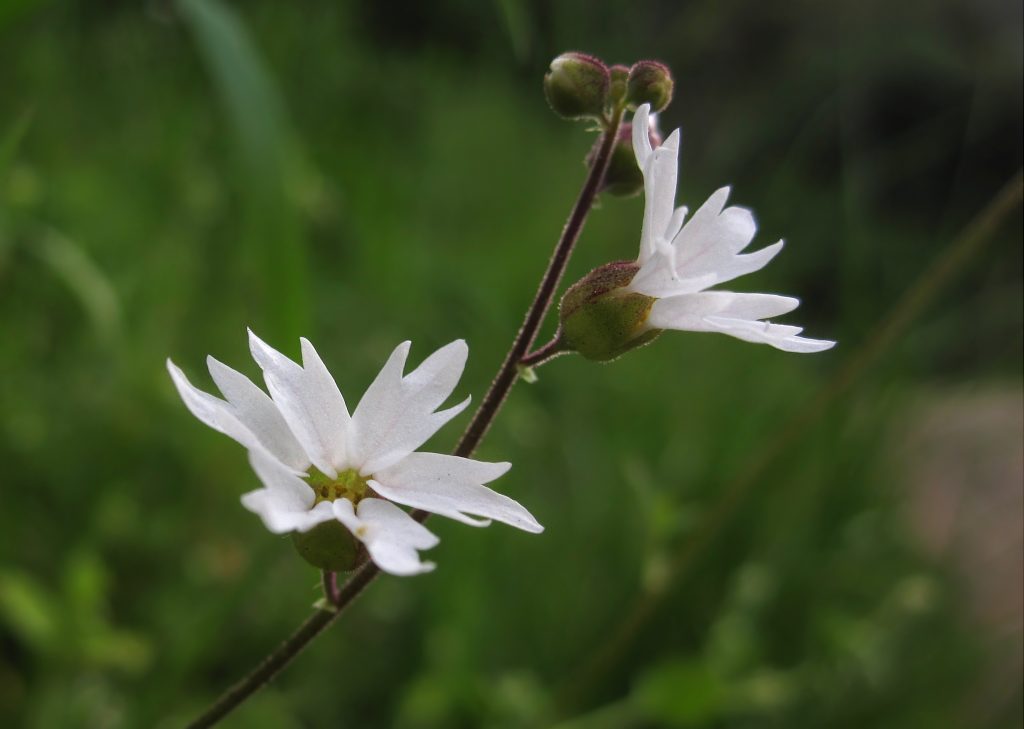
Woodland Stars prefer slopes that are grassy and shaded. At Cherry Canyon that usually means more or less north-facing slopes, where their stalks emerge in sparse groups of twos or threes. The flower is astonishing for the height of that stalk — as short as 6″ or as tall as 20″ or more. The blossoms have five delicate white petals that seem not to touch one another, and each petal typically has three irregular lobes that add to the charm. If you look quite closely, you may see a network of faint pink veins on each petal.
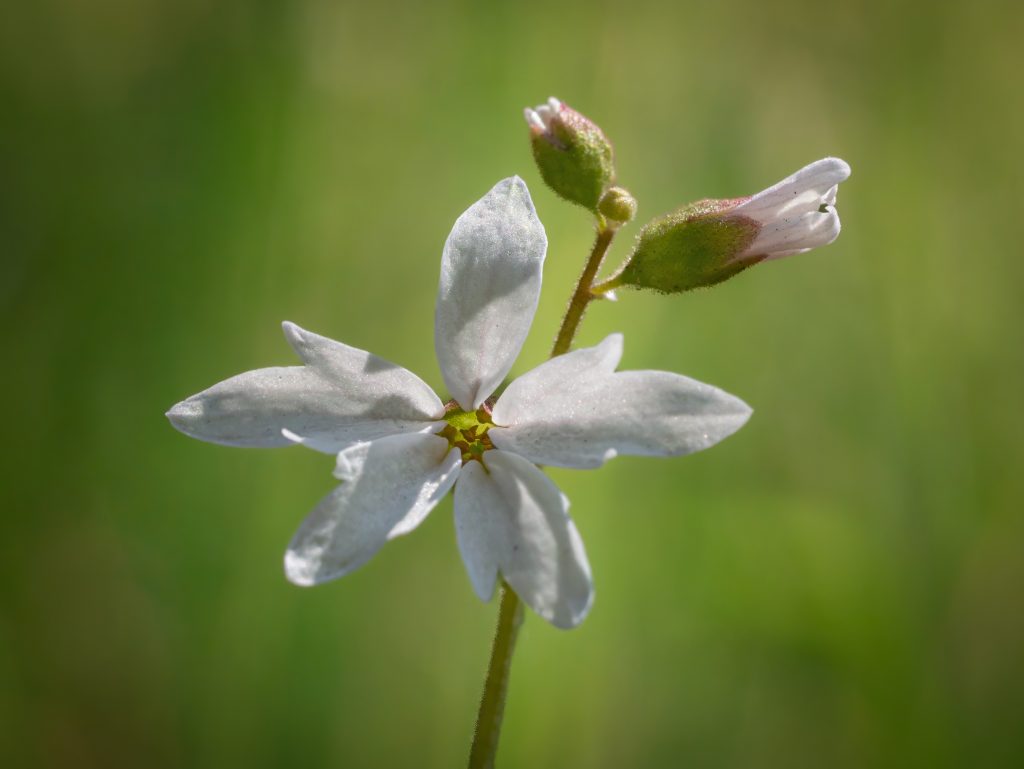
There are nine species of Lithophragma in California. Nearly every county has at least one of these. Cherry Canyon is fortunate to have this particular Woodland Star — “common” according to its name, but un-commonly lovely. Hike slowly this spring, you may find it!
Where and when to find it. Common Woodland Star blooms from March into May in the coastal counties of California. In Los Angeles County it favors almost all of our coastal hills and foothills — even on Santa Catalina Island! It’s found on the shady slopes of the Cerro Negro Trail at both ends, along the Conservancy Trail, and in the shadiest margins of the Descanso Fire Road.
- For more about Common Woodland Star, visit Wikipedia.
- For info about growing Lithophragma affine in your yard, visit Calscape.org.
- For distribution maps, taxonomy, and more photos, visit Calflora.org.
- You can also read other wildflower notes, or check out the LCF wildflower directory.
