
Occasional observations on the wildflowers of 91011.
The La Cañada trail network does an amazing job at getting us into some remarkably rugged areas that nurture a wealth of native wildflowers. But not all those flowers are native, and not all are even wild. Some have been deliberately introduced by humans, sometimes with disastrous results. And some have hitchhiked here — carried by birds, riding on the wind, or sticking to hikers’ boots.
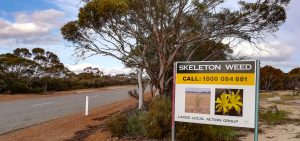
Skeleton Weed is a nuisance worldwide, not only in California but also in Western Australia (pictured).
In many cases, the non-native flowers at Cherry Canyon and on the slopes of Mt. Lukens have so thoroughly infested the slopes and meadows that there is not a ghost of a chance that they will ever be eradicated — plants like Spanish Broom, Fountain Grass, Star-Thistle, several species of Brassica (mustard) … oh, it’s a very long list! But there’s at least one non-native invasive that you may be lucky enough to never see: Chondrea juncea, also known by the unexpected names of Hogbite and Skeleton Weed.
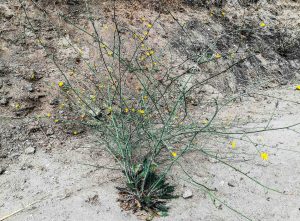
Why never? Because Skeleton Weed is not just any invasive — it’s regarded as a noxious weed throughout the world’s temperate zones, and it’s massively widespread in Northern California. But it has a much smaller footprint in Los Angeles County, with inland infestations discovered only in 2013, at Cherry Canyon, and the pest management division of the L.A. County Agricultural Commissioner is regularly on call when new plants are reported or old plants revive. And well they might be on call, because one plant can produce up to 20,000 seeds in a season! But the vigilance of independent observers and the Ag. Commissioner’s office explains why you’re less likely to see this pest.
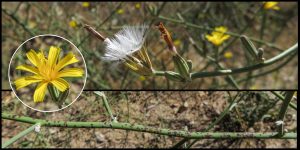
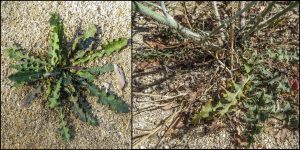
At first glance, Skeleton Weed looks a lot like many yellow asters that remind us of dandelions, with about a dozen yellow “petals” (which are actually ray flowers) that vaguely form an asterisk or star. Skeleton Weed, however, is a distinctly spindly shrub. It springs from a basal rosette (just as dandelions do) and produces prickly green stems, often blotched with maroon. If you see this plant, take some photos and contact the LCF Trails Council.
When and where to find it. Skeleton Weed blooms from July through the fall, though August is generally the best month to find it around La Cañada. It has occurred at several places along the roads and trails of Cherry Canyon, as well as on the ridge that runs south to Glendale Community College, along the Edison easement north of Foothill, and in a few neighborhoods in Flintridge. All known locations are mapped and generally monitored. If you want to see the scale of infestation elsewhere, find this species on Calflora.org and zoom in on its “plant range.”
- For more about Skeleton Weed, visit Wikipedia.
- For distribution maps, taxonomy, and more photos, visit Calflora.org.
- You can also read (or subscribe to) other occasional notes on the wildflowers of 91011.
- And if plant invasions keep you up at night, try this for bedtime reading: Weeds of California and Other Western States, 2 vols., by DiTomaso and Healy (University of California, 2007), ~1800 pages.
