
Occasional observations on the wildflowers of 91011.
Nope, this isn’t an inventory for a construction crew. It’s also not the solution to some New York Times word game (though it could be!). Surprisingly, all these substances pop up in the common names of California wildflowers, such as Turpentine Broom, Creosote Bush, Wax Currant, and the flower we’ll look at here — Greasewood.
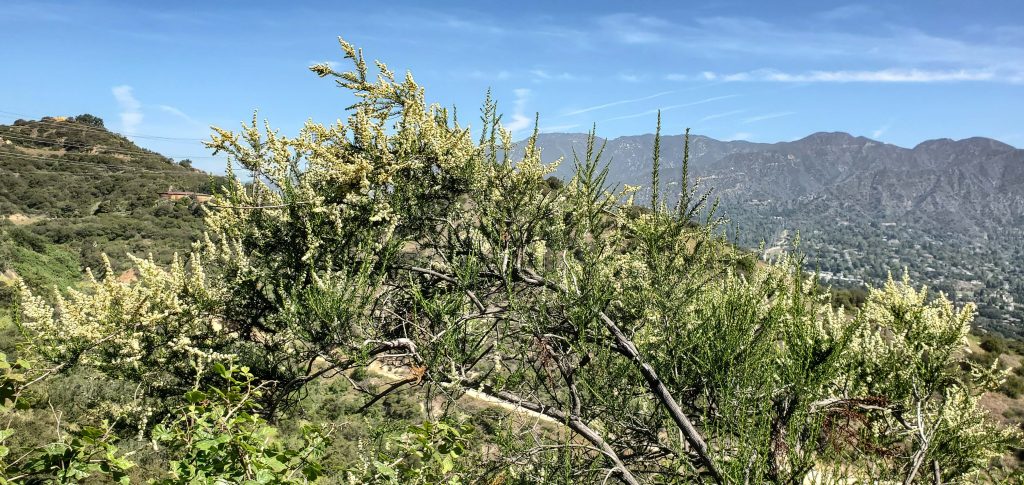
Actually, at least half a dozen plants are nicknamed “greasewood,” which is why it’s better to call our plant by its other common name: Chamise (Adenostoma fasciculatum). But both names hint at the same feature. “Chamise” reportedly derives from a Portuguese word meaning flame, while “greasewood” points to the plant’s greasy, resinous leaves — flammable leaves.
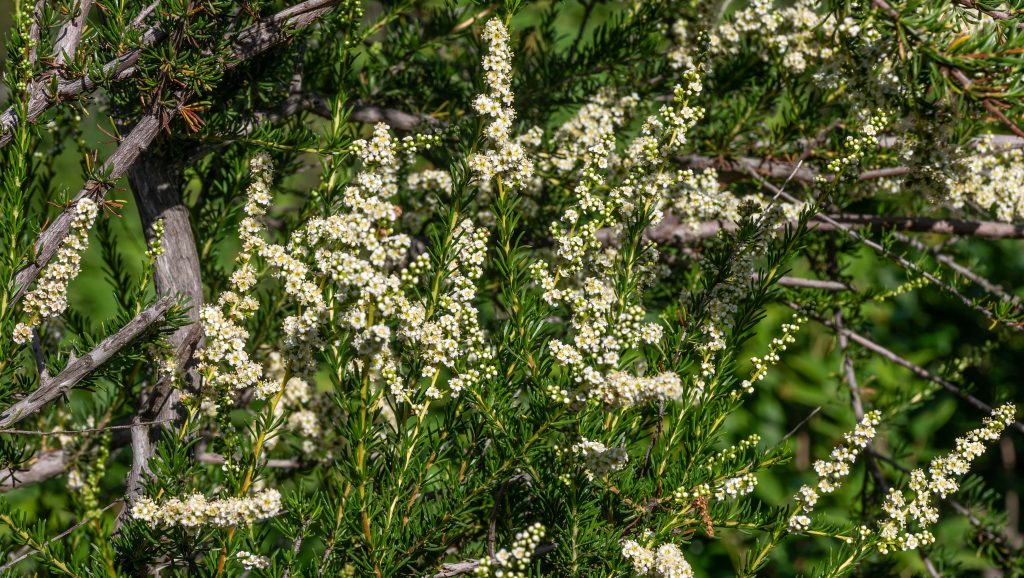
Chamise thus has an odd relationship to wildfire. Without a doubt it’s flammable, yet it is also incredibly adept at surviving fires, because mature plants will develop a large burl at the base that stores starch for food and sends up new buds after a fire. Chamise is ideally suited for dry climates, with roots that may run 25 feet deep and spread to twice the shrub’s diameter. It serves its chaparral habitat as an effective anchor against erosion, as food for deer and small mammals, and as cover for many birds. Some botanists see this woody shrub, so abundant and widespread in its habitat, as virtually defining chaparral, and there are places in the San Gabriel Mtns. where it so dominates hot, south-facing slopes that these areas are described as “chamissal” or “chamise chaparral.”
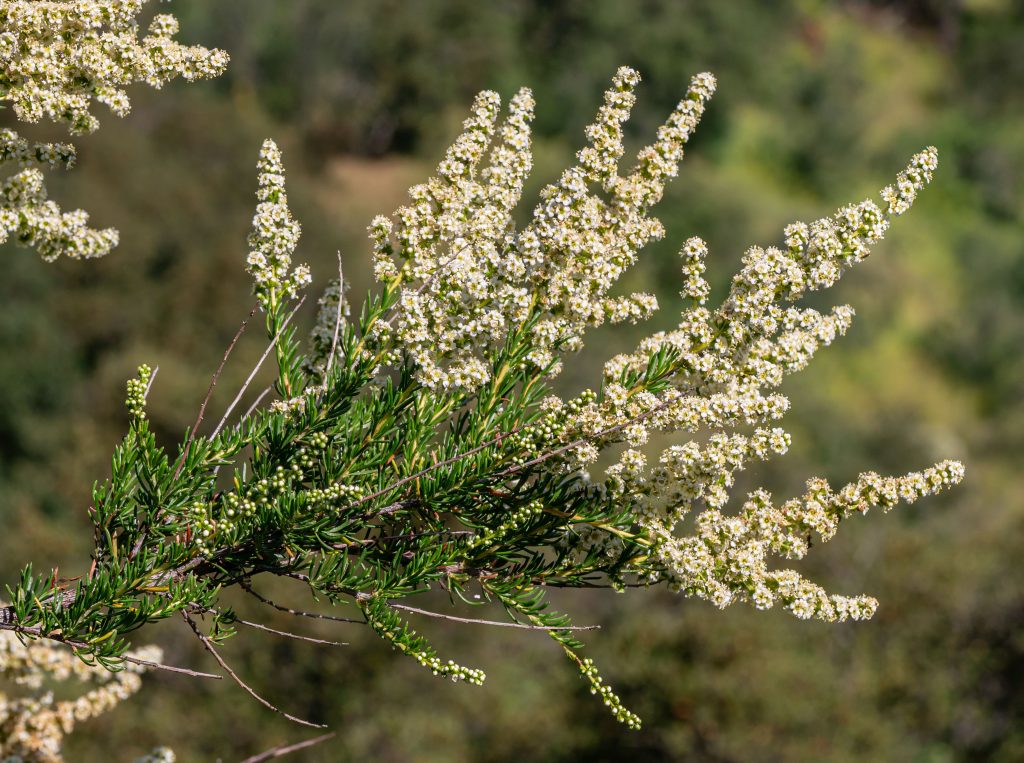
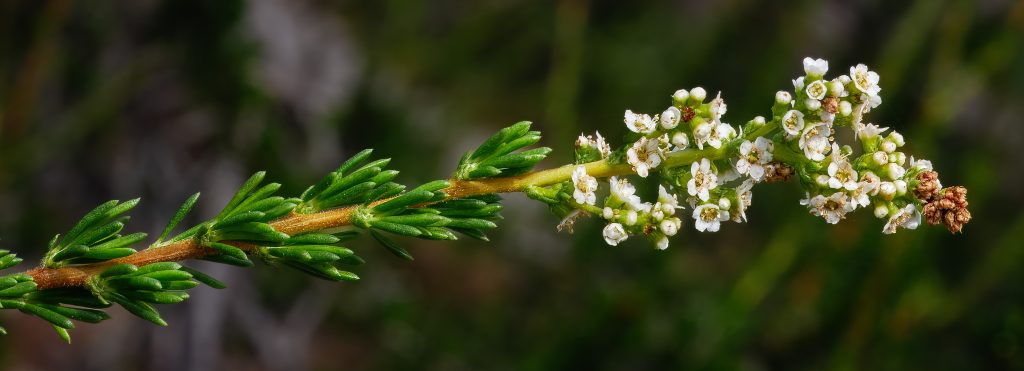
Chamise is also attractive. Its needle-like leaves are remarkably distinctive, similar only to rosemary sprigs or to the leaves of California Buckwheat. But these petite “needles” are attached to the stems not individually but as clusters (“fascicles”) of up to a dozen leaves — easy to identify if you have any doubts! Spring will see creamy white flowers extensively frost the ends of branches. Later, in the heat of summer and fall, the flowers and seed capsules will turn a rusty brown or bronze, visible from far away.
Where and when to find it. Chamise is found only in California and Baja California, favoring the coastal hills and the western Sierra foothills. Statewide, it flowers in the summer months, but locally it’s often a spring bloomer, March through June. It’s found throughout Cherry Canyon and on the flanks of Mt. Lukens, and the Cerro Negro Trail is one of several reliable places to look.
- For more greasewood in general, visit Wikipedia, which also links to Chamise.
- For info about growing Adenostoma fasciculatum in your yard, visit Calscape.org.
- For distribution maps, taxonomy, and more photos, visit Calflora.org.
- You can also read other wildflower notes, or check out the LCF wildflower directory.
